By Sharon Oliver
Contributing Writer
ORLEANS – Much has been said about the surprise military strike on Pearl Harbor in Hawaii in December 1941, and rightfully so. The United States had been a neutral country at the time, but this brazen attack catapulted the nation into entering the war on the side of allies the very next day. Nevertheless, that was not the first 20th century attack on American soil brought on by a wartime enemy.
Tugboat towing barges
On July 21, 1918, a tugboat called the Perth Amboy was traveling along the outer arm of Cape Cod with four barges in tow: the Lansford, Barge 766, Barge 703 and Barge 740. Among the 32 passengers on the five vessels were four women and five children. Just before 10:30 a.m., a deckhand on the Perth Amboy spotted a strange object racing across the waters, and then saw something crashing into the beach in Orleans with a loud, thunderous sound. It was the German submarine U-156, and it soon began firing shells at the small convoy of barges, wounding 13 people.
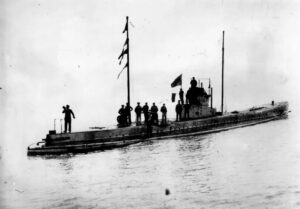
This German submarine, U-156, attacked the town of Orleans during the summer of 1918 in the last months of World War I.
Perth Amboy’s captain James Tapley had been asleep but staggered out on deck after hearing the first blast. Upon realizing their tugboat was heavily damaged and they were powerless against the attack, Tapley ordered his crew to abandon the ship. More than 1,000 curious residents of the sleepy fishing town heard the odd commotion and trickled out of their homes.
They ran to Nauset beach where they witnessed shells floating in the water and flying through the sky. Some shells landed in a deserted marsh and on the beach. The 11-year-old son of one of the barge captains bravely ran to the end of a dock and waved an American flag at the German submarine.
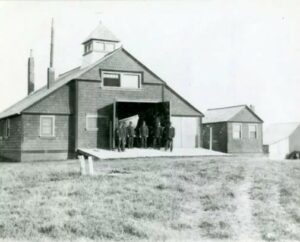
By 11:15 a.m., the Air Service sent two seaplanes from Chatham air base in search of the submarine. The base had been alerted to the attacks shortly after the first shots were fired. Two Curtiss HS-2L flying boats dropped bombs near the submarine but they failed to explode. Thanks to Number One Surfman William Moore keeping watch in the tower at Station No. 40 of the U.S. Coast Guard, lives at sea and on land likely escaped grave peril.
According to a 1938 article in the Barnstable Patriot, Moore climbed down the tower and alerted the station’s keeper, Captain Robert Pierce, that there were “heavy guns firing on a tow of barges east, northeast from the station.”
Rescue of crew and passengers
Pierce immediately ordered the launching of a surfboat and rowed out with Moore and others to rescue the 32 crew members and passengers trapped aboard the tug and barges despite being under heavy enemy shellfire. Pierce, a seaman and lifesaver for nearly 30 years, recalled the lifesaver’s creed: “You have to go, but you don’t have to come back.”
After firing 147 shells in an hour-long engagement, U-156 submerged around 11:30 a.m. Fortunately, there were no fatalities as opposed to the deadly attack on Pearl Harbor.
A sign above the beach commemorates the engagement:
“Three miles offshore, in the direction of the arrow, was the scene of attack of a German submarine on a tug and barges July 21, 1918. Several shells struck the beach. This is the only section of the United States’ coast shelled by the enemy during World War I.”
It was the first time that the United States was shelled by artillery of an outside power since the Siege of Fort Texas in 1846 when the fort was fired upon and besieged by Mexican forces.
The U-boat would continue up the coast attacking other allied ships and is believed to have met its end in a mine field in the North Atlantic two months later.
RELATED CONTENT:
Quincy native Charles W. Sweeney flew both atomic bomb missions in WWII
‘It Needs to Be Told’: Northborough POW’s Hidden Story Shared