By Michael Perna Jr.
Contributing Writer
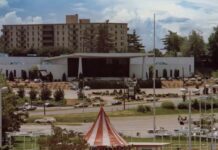
PRINCETON – In the early 1960s, a family trip to the Princeton Antique Automobile Museum in Princeton, proved to be an exciting adventure for then-10-year-old Michael Perna Jr. His parents were friendly with the museum’s founder and owner at the time, Albert Garganigo, who had grown up in Shrewsbury.
Garganigo, who had started out owning the Turnpike Garage and Auto Wrecking business, located near the corner of what is now Route 9 and South Quinsigamond Avenue, started collecting what began to become known as “old” cars in the era around World War I. He eventually opened an antique auto museum on the site. The brick building that housed the museum is still there, home to a number of commercial enterprises.
Fighter plane acquisition
In the 1920s, he had purchased what had been known as the Red Fox Farm, located along Route 31 in Princeton. He began restoring his collection of antique vehicles in the barns on the farm, then storing the restored cars in them. He would display a few of them outside on weekends. People passing by would stop to look at the old cars, and soon he had the idea to build an actual museum building, housing what he called the “Horseless Carriage Exhibit.”
As his collection continued to grow, he added more buildings. The “Museum of Antique Autos” opened in 1937. Eventually more buildings were added, and so were more autos, an antique fire truck, a carousel, antique bicycles, pinball machines, and a variety of other items. After World War II, he was somehow able to acquire the wreck of an Italian Air Force Macchi C.202 fighter plane that had been captured in North Africa.
The hulk of the aircraft was displayed outside on a grassy area near the parking lots for the museum. Although it was a rare artifact – very few similar aircraft were neither captured or for that matter displayed after the war ended – it didn’t seem to attract much attention from museumgoers.
Young Perna was an exception – he had been very interested in military affairs since his earliest years – this would eventually lead to a thirty-six-year career in the United States Air Force. After arriving at the museum, he discovered the lonely wreck and immediately ran over to it. By this time, the aircraft was basically a wreck, with no undercarriage, no propellor or canopy, and rusting metal parts falling off the wings and fuselage. The youngster was somehow able to climb onto the wing, then into the pilot’s seat, which was just about non-existent by that time.
Taking a souvenir
As he pretended to be flying the fighter, he looked down and noticed a small remnant of a leather seat belt strap, still attached to a tiny bit of metal that had secured it. The item was immediately put in his pocket.
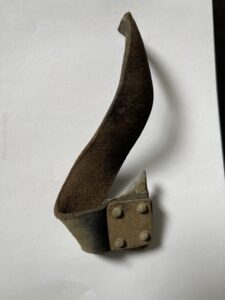
Photo/Michael Perna Jr.
Although he was excited with the “find,” his parents, and for that matter, the museum owner, weren’t very interested. He brought the remnant home, and it was tucked into a cigar box that contained a variety of World War II relics he had collected from various veterans.
Imagine his surprise, when, now in his 70s, a recent internet search about the antique auto museum brought up the fact that “his” fighter plane had eventually ended up at the Bradley Air Museum in Connecticut, then was completely restored and today is exhibited at the National Museum of the USAF in Ohio.
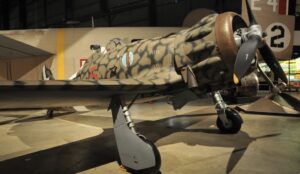
A search of the old cigar box turned up the piece of seat belt strap, and he has initiated getting in touch with the USAF Museum to see if they would like to reunite the artifact with the original aircraft, which would culminate a long and bumpy trip for this little piece of history.
RELATED CONTENT:
Women from Massachusetts colleges served as code breakers during World War II
World War II Gen. George S. Patton lived in Hamilton
Quincy native Charles W. Sweeney flew both atomic bomb missions in WWII