By Sophia Oppedisano
Contributing Writer
NORTHBOROUGH – In 1984, Ralph S. Metcalf sat down with a tape recorder. “This is Ralph Metcalf – 86 Maple Street, Northborough, Massachusetts. I am 65 years old. I am recording this at the request of my grandchildren,” he spoke into the machine.
After Ralph’s passing in 1994, his grandson, Eric, transcribed the tapes and turned them into a book.
Forty years before creating the tapes, Ralph left for England aboard the Queen Elizabeth for his assignment to the 8th Air Force, 390th Bomb Group, 571st Squadron. He flew 16 missions between December 1943 and May 1944 in World War II.
It was during his last mission – a 13-minute bomb run over an aircraft factory in Strasbourg, France – when Ralph and his crew were shot down over enemy territory. Those who survived were taken to a Nazi prison camp in Frankfurt, Germany.
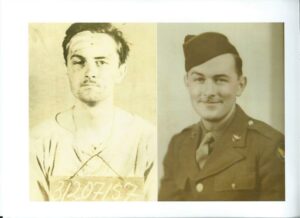
Ralph spent 13 days shy of one year as a Prisoner of War (POW) in three different Nazi prison camps. After he was liberated, he was awarded two Purple Hearts and promoted to Technical Sergeant.
Recently, Ralph’s son, Dave, who works part-time for the Northborough Senior Center, sat in his kitchen with his wife, Barbara, at their home in Shrewsbury. Their walls are adorned with photos of a big, loving family, and mementos of military service fill the space.
On the kitchen table, a spoon from a Nazi prison camp rests next to two photos of Ralph: one when he left for England and weighed 155 pounds, and one when he was liberated and weighed only 100 pounds. Also on the table: a 50-caliber bullet that hit Ralph in the heel while he was held captive.
In another photo, Dave, flanked by his sons Eric and Brian, holds up his father’s uniform at the Parham Airfield Museum in Parham, England. The family recently loaned it to the museum’s POW annex. Dave believes his father had Post-Traumatic Stress Disorder, which was not recognized among veterans at the time, that led to him shielding from his family what had happened to him.
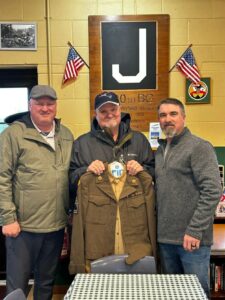
When Dave would ask his father about what happened during the war, Ralph would say, “Nothing really.”
“He kept everything inside. … I’d say, ‘Dad, I want to know what happened,” and he would say, ‘You don’t want to know. You don’t need to know,’” said Dave. “What I gleaned out of this whole experience was that he was a really, really good guy. … But I never realized that until much later in life, and it kicks me.”
Dave and Barbara both recall how Ralph refused to enter closets because of his time in solitary confinement. He wouldn’t eat sauerkraut and Brussels sprouts – even the smell would trigger his memories of the prison camps. Barbara said he always had trouble with his feet from the frostbite he got flying one of his first missions.
Ralph never discussed any of this, but the family knew the war always weighed heavily on his shoulders.
Despite his quiet nature around his family, Ralph was always the “the life of the party” when family or friends were around. He hosted a clam bake in town every year, and his customers at the tire shop he worked at adored him, Dave said.
“But then, when everybody’s gone, I just had to leave him alone. You could tell that’s what he wanted – just let it go,” he said.
It was only when Eric, Dave’s eldest son, joined the U.S. Navy in 1990 that Ralph began to open up about what happened during the war. The tapes were Ralph’s way of letting Eric know that he understood what Eric was going through and that he wasn’t alone in those experiences, Dave said.
Eric transcribed his grandfather’s tapes into a book he wrote for his family – “A POW Story: Memoirs of T/SGT Ralph S. Metcalf.” Eric conducted research for the book, including photos, newspaper clippings, and original telegrams.
In the prologue, Eric writes about his own tours throughout his 25-year military career. “The one thing I could rely on during my first experience in a combat operation was care packages from home,” Eric wrote. “These care packages always consisted of the same thing. A carton of Camel Cigarettes, magazines of all types, newspapers from home, and a note. This note read: ‘These are the items that I missed the most while I was a POW. Be safe and make it home. Love Grandpa Ralph.’”
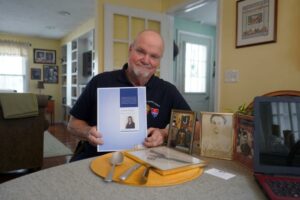
“They had a lot in common,” Dave said. “The reason he went into the service was because of his grandfather.”
Ralph’s tapes and Eric’s book gave Dave a newfound sense of empathy for his father. “It was extremely emotional. I read this thing, and I had emotions going all over the place. But, since [I read the book] and we’ve donated the uniform – that’s where that uniform belongs,” he said.
And with Eric’s book, a heroic, long-hidden story is finally being told.
“This is our way of honoring him,” said Dave. “I want to do this now to let my dad know that I can appreciate what [he] did and I understand what [he went] through. It needs to be told – it just does,” he said.
RELATED CONTENT:
Quincy native Charles W. Sweeney flew both atomic bomb missions in WWII
Framingham WWII veteran honored on 105th birthday
WWII veteran celebrates 101 years at American Heritage Museum