By Michael Perna Jr.
Contributing Writer
BOURNE – In the mid-1960s, during a roughly eighteen-month period from July 1965 to April 1967, Otis Air Force Base on Cape Cod suffered three disastrous aircraft accidents involving the EC-121H Super Constellation aircraft. The EC-121 was a four-engine, propellor-driven aircraft that had been modified from the C-121 cargo/passenger aircraft. It was designed to provide early warning radar in the event of a Soviet attack on the United States.
Essential missions
At the time, Otis Air Force Base was the only USAF Air Defense Command base performing three essential missions: radar picket plane surveillance, fighter-interception, and ground-to-air missile operations. The 551st Airborne Early Warning and Control Wing was the only USAF organization that flew the EC-121 Super Constellation, Warning Star aircraft at that time, flying missions out over the Atlantic Ocean on a 24-hour basis.
The first catastrophic event involving the 551st happened on July 11, 1965, a few months after the wing celebrated ten years in operation without any significant accidents. On that date, an EC-121 from the wing developed an engine fire while on a mission roughly 100 miles from Nantucket Island. The aircraft was forced to ditch into the ocean – the last transmission heard from the pilot was “Altitude 200 feet – I am ditching.” The plane hit the water and broke apart.
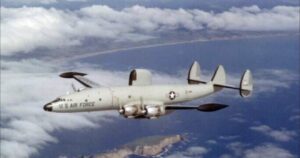
The aircraft carrier U.S.S. Wasp and several other ships that were in the area immediately launched a search and rescue mission, however, of the nineteen men aboard, only three were rescued. Nine bodies were recovered, and the other seven crew members on board were listed as “missing – presumed dead.” One of the men rescued was Airman First Class John Puopolo of Roslindale. One of the casualties was Airman Second Class Charles H. Williams of Worcester.
Second and third crashes
A few months later, another EC-121 from the 551st crashed in the same general area as the first aircraft, on Veterans’ Day, November 11, 1966, due to what were described as “unexplained circumstances.” In this crash, all nineteen crew members were killed and their bodies never recovered.
On April 25, 1967, a third EC-121 crashed into the ocean roughly one mile off the coast of Nantucket, shortly after taking off from Otis AFB. There was only one survivor of this crash, with all of the other fifteen members of the crew dying in this episode. What made this crash particularly hard on the 551st Wing was that the wing commander, Colonel James Lyle, was piloting the aircraft at the time, perishing along with his crew.
Just a few months earlier, Colonel Lyle had presented United States flags to the families of those airmen who had perished in the November 11 crash. Now he had become a casualty too.
Tragic legacy
As a result of these crashes, and improvements in other types of technology, the EC-121 aircraft was phased out, with the 551st Wing being deactivated on December 31, 1969. Otis Air Force Base itself was deactivated and renamed Otis Air National Guard Base.
Today, the only reminder of the three catastrophic crashes is what is called Otis Memorial Park, dedicated to the fifty service members that lost their lives.
In a touching tribute to these service members, Congressman Alan Boyd of Florida, who had been made aware of the incidents by one of his constituents, Senior Master Sergeant (Retired) A. J. Northrup, who had spent four years of his thirty-year career in the Airborne Early Warning and Control mission, read a touching tribute to the casualties during a presentation before Congress on December 15, 2000, more than thirty years after the disastrous crashes had occurred.
RELATED CONTENT:
Cape Cod town was attacked by a German submarine during World War I
Princeton Fighter Plane’s Journey Through the Decades
‘It needs to be told’: A long-hidden story about a Northborough POW finally being shared