By Michael Perna Jr.
Contributing Writer
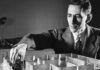
QUINCY – Today the name may have faded from most people’s memories. In fact, one would be hard pressed to find anyone except history buffs who might recognize the name of Charles W. Sweeney. What today’s citizens don’t realize is that then Major Charles W. Sweeney, a Quincy native, was not only the sole aviator to fly on both atomic bomb missions in World War II, which happened 80 years ago last month. He was actually the pilot of the B-29 Superfortress named “Bock’s Car” that dropped the second atomic bomb on Nagasaki, Japan on August 9, 1945.

Sweeney had trained for these missions under the supervision of Colonel Paul Tibbets in the 509th Composite Group. The atomic missions and all related activities were highly classified, falling under the code name of “Silverplate.”
Complicated mission
After piloting the B-29 “Great Artiste,” which was used as the instrumentation and observation aircraft on the August 6, 1945, mission that dropped the first atomic bomb on Hiroshima, Japan, Major Sweeney was selected to pilot “Bock’s Car” on the mission to attack Nagasaki.
Despite a faulty fuel pump, a missed rendezvous with one of the support aircraft, and cloud cover over the primary target, a city named Kokura that caused the target to be switched to Nagasaki, Sweeney persisted in the attack. Nagasaki was bombed with the second atomic bomb, nicknamed “Fat Man.” The resulting destruction caused the deaths of an estimated 35,000 to 40,000 inhabitants, and severely damaged Japan’s war industry.
”Bock’s Car” barely made it safely back to the airfield on Iwo Jima due to a shortage of fuel, with two of its four engines quitting as the aircraft landed. Despite some calls for Sweeney to be disciplined for pursuing the attack while knowing of the limitations caused by the fuel pump issues, no adverse action was taken – he actually received the Silver Star Medal for his actions on the mission.

Photo/U.S. Air Force
Post-war career
After the war was over, he returned to his home state of Massachusetts and became a member of the Massachusetts Air National Guard, eventually becoming the organization’s commander. He retired in 1979 as a major general.
It was years later that I met Major General Sweeney in person. I had served under his command during the 1970s but had never gotten to speak to him. This event occurred in the 1990s, when one of his sons, who was an officer in the Marine Corps Reserve, decided to get commissioned in the Air National Guard in Worcester. The general decided to administer the oath of office to his son.
As one of the unit members that had served under General Sweeney, I was asked to escort him around the base until the swearing-in ceremony.
I distinctly remember the day – the general, by now a portly older gentleman with gray hair and a cane, dressed in a gray suit came walking up to the entrance to the building accompanied by a stately older woman.
I greeted him in the entryway, saying “Sir, welcome to the base. I’m sure you don’t remember me, but I served under you back in the 1970s.” He shook my hand and said, “Of course I remember you – Sergeant Perna” (as he looked at my last name on my uniform’s name plate). He then introduced me to his “Good friend, Miss Murphy.” It turned out that Miss Murphy was indeed his long-time friend, the general having been divorced for many years.
As his son’s paperwork hadn’t been completed yet, I invited them to sit down and have a cold drink while we waited for the ceremony to take place.
Somber conversation
After being seated, I asked if the general would be open to talking about his historic missions, as I was a long-time military history buff. He quickly agreed, but his demeanor changed from a talkative, outgoing older gentleman to a more serious, pensive person.
He answered my questions, making it clear that even after so many years, he fully supported the dropping of the atomic bombs. He said, “It was something we had to do. The Japanese refused to surrender despite their military being defeated and their country being destroyed,” he explained. “They were launching kamikaze suicide attacks and training civilians to resist to the death. We would have lost many thousands of our young men if we had to invade the Japanese homeland,” Sweeney noted. “We knew we had to succeed in our mission, as we had been briefed that the United States didn’t have any more atomic bombs to drop on Japan. It was now or never, that’s why I chose to pursue the mission despite several setbacks.”
When asked if he had any misgivings later in life, he said that he had none and given the same circumstances would have done it all over again.
It was then time for the swearing-in to take place. After the ceremony, I escorted the general to the door. He shook my hand and bid me goodbye. He and his friend Miss Murphy slowly walked down the sidewalk, marking the conclusion of an unforgettable afternoon spent with a part of history.
Major General Charles Sweeney, USAF (Retired) passed away in 2004 at the age of 84.
RELATED CONTENT:
Waltham man chronicles his grandfather’s amazing life in new book
Southborough resident works to ensure African American military regiments are not forgotten
WWII veteran celebrates 101 years at American Heritage Museum