By Michael Perna Jr.
Contributing Writer
WORCESTER – Loring Coes is a man that is all but forgotten to all but a handful of people in these modern times. What the majority of people do not realize is that, if not for Mr. Coes, life in modern times would be much harder. Why would that be? Imagine a world in which mechanics, plumbers, and everyday residents did not have one invaluable tool – the monkey wrench. How would you tighten a faucet, or a pipe, or a million other things without that tool?
Coes, who was born in Worcester on April 22, 1812, became a well-known figure in the city. He entered politics, becoming a member of the Board of Aldermen, then the Worcester Common Council, and eventually a member of the Massachusetts House of Representatives, serving from 1864 to 1865.
He and his brother, Aury Gates Coes, had been working for the firm of Kimball and Fuller, which made machinery for the woolen business. They eventually purchased the business and renamed it the L. & A. G Coes Company. Unfortunately, a fire destroyed their business in 1839, at which time they moved to Springfield, working as pattern makers in a foundry.
Originally called a screw wrench
It was during this time that Loring came up with the idea of what was at the time called a screw wrench and would eventually become known as the monkey wrench. His invention was a significant improvement over the two most commonly used wrench types prior to that time, which needed two hands to operate. His could be operated with only one hand if necessary.
In order to pay for the patent on the monkey wrench, the brothers sold the pattern for spinning machines that they salvaged from the fire in Worcester. The patent for the new wrench was granted on April 16, 1841.
The Coes brothers went on to produce these wrenches for many years at their facility in Worcester, located at what became known as Coes Square, near what is still known as Coes Pond.
Photo/Wikimedia Commons
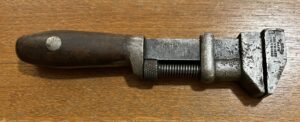
They eventually held a number of patents for several types of wrenches and improvements to the original monkey wrench design. One of these was named the “knife handle wrench,” which had a wooden handle, a throwback to number of wooden handled knives the company also had produced.
Built to last
An example of the lasting longevity of these sturdy wrenches: This writer’s grandfather, Rocco LaComfora, an Italian immigrant who lived in West Boylston and became a boiler fireman, passed a Coes wooden handled wrench down to me. At the time, back in the early 1970s, he told me, “This is a good wrench – it will last a long time for you!” It was good advice – the wrench has been used ever since on any number of projects.
Of course, we must not forget what became a commonly used saying, based on the solid construction of the Coes monkey wrenches – to “throw a monkey wrench into (something)” became widely used.
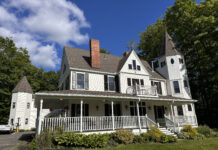
Loring Coes himself lived until the age of ninety-four, passing away on July 13, 1906, in his hometown of Worcester. His mansion in Worcester, located at 1049 Main Street, was part of a larger family estate situated around what is now the Webster Square area of the city. Much of the former estate is now occupied by the Webster Square Towers complex of apartments.
Many people ask where the name “monkey wrench” originated. There are a number of theories as to why it became known as that, with no one being able to definitively ascertain where the name came from. One of the most interesting theories, however, is that the jaws of the wrench resemble a monkey’s face.
Loring Coes and his Worcester invention, the monkey wrench, is a unique hand tool that has made life a lot easier for generations around the world ever since.
RELATED CONTENT:
Worcester City Hospital served residents for over a century
Hotel Bancroft was once Worcester’s premier lodging and event destination