By Sharon Oliver
Contributing Writer
REGION – Playgrounds originated as “sand gardens” in Germany in 1885. Although the first children’s playground to offer swings, slides and a carousel opened in San Francisco’s Golden Gate Park in 1887, the concept of building public playgrounds was birthed before then with the first basic playground getting built in Boston in 1886, thanks to a local group of female philanthropists.
At the time, children living in the countryside had open fields to burn off energy and kids from wealthy homes had private yards to let their imaginations run wild. But city kids, particularly those from immigrant and working-class families, had no safe communal space to romp and play.
Concern for public welfare
As industrialization and urbanization grew, so did concern for public welfare. So, members of the Massachusetts Emergency and Hygiene Association (MEHA) envisioned playgrounds as the solution to the cramped quarters and social isolation children faced. It would also help youngsters develop physical health, socialization skills and cherished memories of a joyful childhood.
After hearing about how children in Berlin flourished when given access to public spaces to play in, the organization arranged to have a pile of sand dumped in a North End churchyard in the summer of 1884. MEHA chair Kate Gannett Wells wrote in the organization’s annual report, “playing in the dirt is the royalty of childhood, but poverty infringes upon the right.”
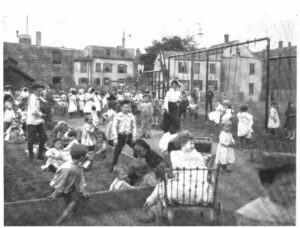
In 1889, Boston’s “outdoor gymnasium” opened with swings and seesaws. However, playgrounds became a controversial topic by the early 1900s. Residents of Newburyport feared playgrounds would also attract large gatherings of young people and crime. The Newburyport Public Playground Committee report of May 1912 addressed the new Massachusetts act requiring playgrounds in cities with populations over 10,000 which resulted in trained supervision for each playground. Playgrounds had limited hours of 10 a.m. to 12 p.m. and 2 p.m. to 5 p.m. for the months of July and August with an age limit of 12 years.
In 1906, the Playground Association of America was formed to promote the ideas of playgrounds to communities and playground designs have transformed over the centuries. From the 1880s to 1890s, they began as sand gardens and morphed into model playgrounds with merry-go-rounds and other twirling contraptions.
Hazardous but fun
Many will remember what the playgrounds of the 60s and 70s represented: unbolted swings that could turn children into human projectiles, wood-splintering seesaws, death-defying jungle gyms, merry-go-rounds that often meant Mary-goes-down and metal slides that would burn your legs and thighs on the way down, leaving a searing and lasting impression. Of course, there were also those high reaching yet slippery monkey bars that might have built upper arm strength, but landfall was usually on a slab of concrete. Bruises and broken bones were sometimes just part of the childhood experience.
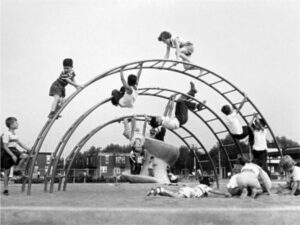
Although those playgrounds lacked protective barriers, none of that mattered to kids since it all meant hot fun in the summertime. As Danielle Norville MacLennan put it on Facebook, “I’ll never forget that playground at the Old Wood School. It was unlike anything I’ve ever seen and so much fun. I was so sad to see it was torn down.”
In keeping with what the women of MEHA started, former New England Patriot Rob Gronkowski has brought the state of play back to the forefront, minus all that metal or sand. The onetime tight end’s new state-of-the-art Gronk Playground promotes imagination and physical fitness and has been a long-held dream for the beloved athlete since his days of recovering from arm surgery across the street at Massachusetts General Hospital.
According to Gronkowski when asked by Masslive.com, “I had every opportunity to compete growing up as a kid, and I was fortunate to have great people around me, good kids to play with, and places where we could be active all day long.”
RELATED CONTENT:
‘Romper Room’: A Look Back at the Classic Children’s TV Show