By Sharon Oliver
Contributing Writer
CAMBRIDGE – Widespread use of cell phone cameras has turned most of the world away from taking camera snapshots on film. But Polaroid Corporation, founded in Cambridge in 1937, was a pioneer in bringing instant gratification to photographers who didn’t want to wait to have their film sent out to be developed.
First instant color film
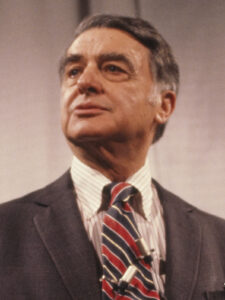
Although the Eastman Kodak Company was established in 1888, Polaroid was the first to launch instant color film in 1963. The original Polaroid Corporation (Land-Wheelwright Laboratories) was founded in by Edwin Land and George W. Wheelwright III and the name “Polaroid” was coined by Professor Clarence Kennedy of Smith College, a mutual friend of Land and Wheelwright.
Described as “The Bill Gates of his era,” Land dropped out of Harvard in 1932, just one semester shy of graduation. The Boston Globe called him a “juggernaut of innovation and the ‘Apple’ of its time, a scientist leader who guided the company as the founding CEO for four decades.”
Photo/Wikimedia Commons
Polaroid’s initial market was in polarized sunglasses, but the company’s scientists quickly developed a reputation for problem solving and the U.S. military repeatedly turned to Polaroid for help with the surmounting technological challenges it faced. For the military, Land and his team created glare-screening goggles, polarized gun sights, glare-proof airplane glass, and a 3-D machine for training machine gunners which later became the forerunner of arcade games. Polaroid’s workforce grew into the thousands, but a return of peacetime meant a decline in military contracts and the workforce shrank to only a few hundred.
Vacation inspiration
Land’s breakthrough inspiration came during a family vacation in California. He took a picture of a burro for his three-year-old daughter, Jennifer, who wanted to know why she could not see the photo that instant. The question spurred his imagination. Land thought about it and one day, many years later, he recalled taking upon the task of solving the puzzle. Within one hour, the camera, the film, and the physical chemistry became so clear to him, and he hurried over to where a colleague was staying to describe to him in great detail a dry camera which would produce a picture immediately after exposure. The fifty-seven manufactured units of the Land Camera that were put up for sale at the Jordan Marsh department store in Boston 1948, all sold on the first day.
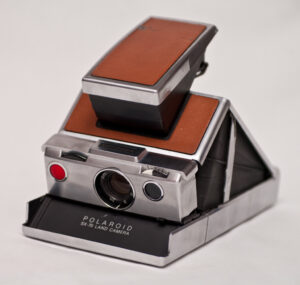
Polaroid Corporation of Cambridge was a pioneer and market leader in the instant photography industry, producing both cameras and film.
Photo/Wikimedia Commons
In October 1970, two African American employees at Polaroid called upon other co-workers to leave their jobs until Polaroid ceased all business in South Africa. Frank & Hirsch was a South African distributor that sold Polaroid products to the South African government during apartheid, an act that violated a prior agreement with Polaroid. Polaroid sent two black and two white employees to South Africa to assess the situation, which resulted in the company severing its ties with Frank & Hirsch. Polaroid went on to establish a foundation to subsidize black education in South Africa and made $25,000 in contributions to black cultural associations.
Camera war and decline
At one point, Kodak was once a customer for some of Land’s polarizing products but then a bit of a camera war broke out between the two photography giants. However, Polaroid won a huge victory in 1985 when a judge ruled that Kodak had violated Polaroid’s patents for instant photography, ending the nine-year legal battle between the two companies. A few short years later, things would change and affect them both dramatically.
By 1991, Polaroid had a workforce consisting of 14,000 workers but even they could see the digital age looming from the horizon. Over the years, payroll numbers continued to dwindle and one day in 2001, workers walked into the Waltham plant only to learn that the company had filed for bankruptcy. It would be the beginning of the end of what will always be remembered as a pioneering era in photography.
RELATED CONTENT:
Norwell’s Janette Kelley was the driving force behind the Betty Crocker brand
The chocolate chip cookie was created in a Whitman inn
Iconic Converse Chuck Taylor All Stars sneaker got its start in Malden