By Michael Perna Jr.
Contributing Writer
BOSTON – Way back in the 1950s, Boston’s WBZ-TV featured a program on channel 4 – the “Big Brother Bob Emery Show.” The show was geared to youngsters, who “Big Brother” called “Small Fry.” By the time the show hit TV, Emery was an elderly looking gentleman – he was born in 1898.
Start in radio
Emery, who was born Claire Robert Emery, started off in the early 1920s performing with a musical group from Gilchrist’s Department Store in Boston where he worked in the shoe department. That lead to a number of roles on various radio stations. One of these involved a program geared to young children, which was known as the “Big Brother Club” on radio station 1XE (later WGI). Initially, he was tasked to read stories and respond to children’s letters to Santa. The kids who listened in could apply to be members of the club – they would receive a membership card and pin if they promised to do good deeds and be good citizens.
Eventually he began a club magazine and would organize events at various locations in the Boston area. He also started a weekly column in the Boston Herald where he would ask children for their opinions on a particular subject, then publish the responses that he received.
Over the years, he became a widely known radio personality, with thousands of kids from across the United States becoming members of his club. He travelled all over the country as a result. In the 1930s he began his television career, even though very few people actually had TVs at that time.
TV career
By the early 1950s he wanted to settle down back in the Boston area and he reached a deal with WBZ-TV to host a kids show. He would start each daily show with a toast (with a glass of milk) to the President of the United States – the song “Hail to the Chief” would be played. This writer, who is seventy-five at this time – vaguely remembers the portrait of then-President Dwight D. Eisenhower filling the screen of his family’s black and white television every day as Big Brother’s show came on. The beginning of each show would also include Big Brother Bob Emery singing the song, “Oh, the grass is always greener in the other fellow’s yard” while strumming his signature ukelele.
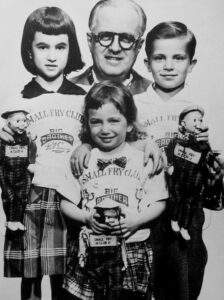
During each show, which aired at 12:15 p.m. each day, Big Brother would engage the young children in the audience. He wanted to include them in whatever activities he participated in, as opposed to them just being spectators. Emery’s goal was to help each and every child that was present to not only be entertained, but to teach them new things and make them feel worthwhile, no matter what their social or economic background might be. He wanted to teach the “Small Fry” – as he called them – good values. It is reported that he was especially proud of the number of kids that he taught the Pledge of Allegiance, for instance.
Fundraising efforts
Bob Emery became an avid fundraiser for many different causes. One outstanding example was when a devastating tornado ravaged central Massachusetts in June 1953, he helped raise $18,000 – much of which was raised by children that were members of his “Small Fry Club.” The money was used to help children and their families whose homes had been destroyed in the disaster.
By the 1960s, WBZ was making changes to Emery’s show, changing it from daily broadcasts to once a week, for instance. He retired in 1968 at the age of seventy.
Big Brother Bob Emery – a kind and beloved TV personality for area children for many, many years, passed away in 1982 at the age of eighty-five.
RELATED CONTENT:
‘Candlepins for Cash’ was a strike for Boston area television viewers
WBZ’s Dream Team represented a golden era of television news
Rex Trailer was the beloved real cowboy on the kids show ‘Boomtown’