By Michael Perna Jr.
Contributing Writer
WORCESTER – During the late 1800s and into the early 1900s, a new style of housing, the three-decker, was created in Massachusetts, with most accounts stating it originated in Worcester. The style of home was created in order to meet several demands created by the influx of immigrants from a number of different countries during those years.
Practical considerations
First, the three-decker houses would require smaller lots due to smaller, shared yards and would house more people. Second, large numbers of workers would be able to live closer to the many factories that existed in the area back in that era. Extended families were able to live in the same houses together, and large number of workers were able to live in close proximity to the many factories and mills that were operating in Worcester during that time. In addition, many of the units were owner-occupied, with the owner living on one floor (usually the ground floor), with tenants on the other two floors.
Large numbers of three-deckers were built in certain areas of the city, including the Vernon Hill neighborhood, where most residents were Irish, Swedish, Polish, and Lithuanian. Shrewsbury Street and adjacent areas housed Italian families; and the area known as Main South, was where Irish, Polish, and Lithuanian families, along with some Italians, lived.
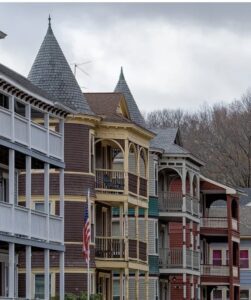
The houses themselves were of light-framed, wood construction, usually with each floor having identical floor plans. Most had two or three bedrooms, along with a kitchen or pantry, a bathroom and living room. Some houses were somewhat larger and divided into three apartments on each side.
The closeness of the houses, made possible by very small (if any) yards and virtually no driveways, made for tight-knit little communities within the community.
Close proximity to all their needs
Some area residents spent their entire lives living in their three-decker apartments, with the close proximity to neighborhood shopping, public transportation and employment eliminating the need for having an automobile. As an example, this writer’s aunt and uncle spent their entire adult lives (1920s-1990s) in the same third-floor apartment of a three-decker located on Granby Road, in the then predominantly Italian Shrewsbury Street neighborhood of Worcester.
The three-decker was usually thought of as a New England phenomenon, with many thousands of them being constructed in the Worcester and Boston areas. This was in contrast to other urban areas such as New York City, Baltimore, Philadelphia, and Washington, D. C., where narrow, single-unit row-housing was more widely used.
Most three-deckers featured a bay window on the front side, windows on all four sides, and a utility porch on the rear of the building. The buildings typically were either gable-, flat- or hip-roofed.
They endure despite drawbacks
Due to a number of reasons including the fact that they were constructed using only wood, mostly used what was known as “balloon framing,” had primitive electrical systems, and used gas-on-gas appliances and had petroleum-based shingles on the outside walls, three-deckers have become well-known for their susceptibility to large, destructive fires.
Despite that fact, the three-decker has continued to endure over the years, into the 21st century. Many units have been updated to make them safer and more energy efficient. Although many of the original occupants and their descendants have moved to single-family homes in the suburbs, the three-deckers still house thousands of people in Worcester’s various neighborhoods, although the population has become even more diverse. A number of three-deckers have become local historical landmarks and have been added to the National Register of Historic Places.
Worcester’s trademark three-deckers – approximately 4,000 remain standing in the city – will serve the area’s residents for many more years to come.
RELATED CONTENT:
Robert H. Goddard: The Pioneer of Modern Rocketry
Green Hill Park is the ‘crown jewel’ of Worcester
Worcester’s trolley system was once the largest in the state