By Michael Perna Jr.
Contributing Writer
WORCESTER – Worcester’s now long-forgotten electric trolley system was one of the earliest in the entire country. What began in 1863 as the Worcester Horse Railroad Company, using horse-drawn streetcars, was replaced in 1889 with electric street railway lines, becoming known as the Worcester Consolidated Street Railway.
Trolley network expansion
Within a few years, the trolley network not only covered all of Worcester, but had been expanded to area towns, such as West Boylston, Leicester, Auburn, Holden, Millbury, Grafton and Shrewsbury, and even farther away locations such as Webster, Fitchburg and Gardner.
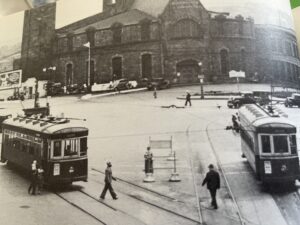
One extremely popular destination for trolley passengers was the area around Lake Quinsigamond, with not only a large number of social, ethnic and boating facilities, but the hugely popular Lincoln Park and more modern (opened in 1905) White City Amusement Park, which stood on the western and eastern sides of the dirt causeway that crossed the lake between Worcester and Shrewsbury.
Old photos of trolley cars in that area show them packed with passengers, including people hanging on to the sides of the open cars. The only other means of getting down to the “Lake” at that time were by horse-drawn carriages, on foot, or taking the old Worcester and Shrewsbury narrow-gauge railroad from Union Station down to its terminus on Lake Avenue. Despite several attempts to lengthen the tracks to Shrewsbury, the line was never expanded to that town, despite the name “Worcester and Shrewsbury Railroad.”
Largest in the state
By 1916, Worcester’s trolley system was the largest in the entire state, with 429 cars in operation.
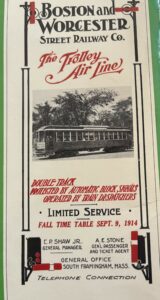
A portion of the trolley line was shared with the Boston and Worcester Street Railway, running from downtown Worcester, then across the causeway into Shrewsbury before branching off from the Worcester line at a point close to what is now the intersection of Route 9 and Harrington Avenue, where the lines split. The Worcester line continued east up Route 9, then up Maple Avenue to Shrewsbury Center. The Boston line ran parallel to Route 9 up to a (then) level-grade crossing halfway between Oak and Lake Streets, where it then continued on parallel to Route 9 but on the western side.
The rails would have to be manually switched at what was then called “Lake Junction,” depending on which destination the trolley was headed for, Boston or Shrewsbury Center. Michael Perna Sr., who grew up in the nearby neighborhood, recalled how, as young boys, he and his friends would sit by the split in the tracks, waiting for a trolley to come by. Depending on which way the trolley was going, they would switch the tracks, which would save the trolley operators from having to stop the trolley, then going over to make the switch, and then returning to the trolley before continuing their trip.
Most of the trolley conductors were very appreciative for the boys’ help and would toss them some pennies for their efforts, at which point the boys would scurry around to gather the coins up. One not-so-friendly operator, however, wouldn’t toss them any pennies, so the boys, upon seeing him approaching, would make sure the switch was turned to the opposite side from what direction he needed to go, then run off before the irritated operator could catch them!
Financial troubles
Things had been changing over the years, with more automobiles and buses becoming used, which resulted in the trolley system becoming used less and less. This resulted in financial troubles for the company. In 1942, the company made it known that all remaining trolley service would be replaced by buses within three years.
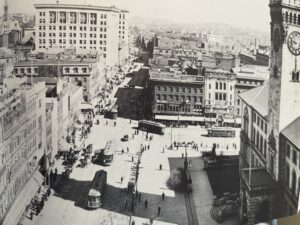
Two different accounts exist as to exactly when the last trolley trip took place in the city – one states that it took place on December 31, 1945, leaving Leicester for Worcester at 1:36 a.m. with the driver, Leopaul Snyder, being featured in a Worcester Telegram newspaper. The other version is that Route 19, which served Lake Avenue and Lincoln Street, ceased operations in 1947.
After converting the operation over to bus lines, the trolleys were sold off, with many ending up in Rio de Janeiro, Brazil.
Today, the only vestiges of the once bustling trolley system are small bits of where the trolley right-of-way once existed. Even the large-scale maintenance facility on Grove Street, which was later used to service the company’s buses, has been demolished, replaced by a number of retail businesses.
RELATED CONTENT:
‘The Whistler’ was a Worcester legend
Speedy’s Drive In was an iconic Worcester destination
Worcester was the birthplace and is still the home of Table Talk pies