By Michael Perna Jr.
Contributing Writer
WORCESTER – Aaron Adams of the Massachusetts Bay Colony obtained thirteen acres of land in 1713 located in what is now Worcester, Massachusetts. He probably never would have believed that his property would now be known as the “crown jewel” of Worcester – Green Hill Park.
Family property
Adams built a house on the property the following year and then started adding to his land holdings. Adams’ brother Thomas later took over ownership of the property. In 1754, Dr. Thomas Green purchased the property, which then became known as “Stormont” and sometimes “Green Hill.” Green’s son, Dr. John Green, inherited the property, building the Green family homestead in 1757.
By the late 1700s, the family had more than doubled the size of their land holdings. In 1848, Andrew Green took over ownership of the family’s land. Andrew moved to New York City, where he became the commissioner of Central Park. His interest in landscaping led him to beautify the Green Hill property with many varieties of ornamental trees. He also enlarged an existing house to a forty-two-room mansion.
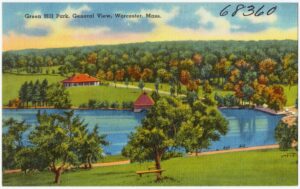
In 1872, Andrew’s brother Martin became the manager of the estate. His background as a civil engineer led to him making several changes, including the creation of what is now known as Green Hill Pond.
City takes ownership
Andrew Green died in 1903. He had willed his property to his nieces and nephews. They, in turn, sold the property to the City of Worcester in 1905. The family mansion was then turned into a resource for a variety of uses – a sort of shelter for women and children, a laboratory to study native birds, a meeting room for the Worcester Natural History Society, and a children’s hospital.
In 1911, a pavilion, known at the time as “The Refectory” was built, followed in 1919 by a nine-hole golf course. During the 1920s, more improvements were made. A bathhouse, golf clubhouse, and a memorial grove dedicated to Worcester’s residents that perished in World War I were added.
More additions to the park followed. In 1929, a “bowling green” was built on land adjacent to Lincoln Street. This was later transformed by the addition of a pool, basketball courts, and an archery range. In 1942, a field house, called the Thomas Holland House, was built by the Works Progress Administration on the site, along with a wading pond, called the Holland Rink. This later became a neighborhood park when Interstate 290 was built through part of the park property.
Military and other uses
In 1957, a portion of the park, located on what was called Millstone Hill, was turned over to the state of Massachusetts so that an Air National Guard armory could be constructed. When completed a radar installation was added to the site. This sometimes-caused issues – in the 1970s, a resident that lived on the other side of the park would frequently call and complain that the radar beams interfered with his television reception! The Air National Guard used the facility until 2000, when it was turned over to the Army National Guard.
An area close by the armory had been used by the city as a dump for many years. After issues with illegal dumping, the dump was closed, only to be reopened as a landfill in 1971. This, in turn, was closed in 1973, with the area being turned into sports fields.
In 2002, the Massachusetts’ State Vietnam War Memorial was dedicated in the park. That same year, work began on the Worcester Technical High School, which is located on what had been part of the park.
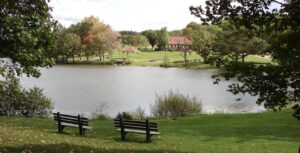
The park has continued to change over the years – the mansion building was demolished, a zoo that once housed buffalo in addition to many other animals has been downsized, and other improvements made.
Today, Worcester’s largest park at 470 acres, Green Hill Park, continues to be an extremely popular destination for all types of outdoor activities, not only for city residents, but for people throughout the local area.
RELATED CONTENT:
The Blackstone Canal connected Worcester to the Atlantic Ocean
Worcester’s trolley system was on
Bicycle racer Marshall Walter ‘Major’ Taylor was known as the ‘Worcester Whirlwind’