By Evan Walsh
Contributing Writer
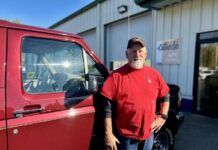
GRAFTON – One day, Andy Kjellberg’s chief came into North Truro Air Force Station in an especially chipper mood. He’d been given orders: He was heading to a different command, and he’d be leaving soon. Kjellberg wanted to get out of Massachusetts. “Can I go with you?” he quickly asked.
“Never asked him where he was going,” Kjellberg remembered.
At 3 a.m. the next morning, an envelope was thrown on Kjellberg’s desk. As the sun rose, he went to the chow hall, made a cup of coffee, and took a big swig. Then he read the envelope. Immediately, he spit his brew into the just-pressed uniform of a nearby staff sergeant.
“That’s when I found out that I’m going to Vietnam,” Kjellberg said.
Soon enough, he was on a plane to fight in a war halfway across the world. It was the start of a journey filled with near-death experiences, but along the way, he found his life’s purpose. For the last three decades, Kjellberg has spent almost every spare moment researching Grafton’s veterans, ensuring that no Grafton resident that served the U.S. goes unrecognized.
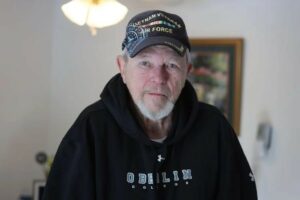
“I took this job for one reason: It needs to get done,” he said.
Joining the service
A Worcester native and Saint John’s graduate, Kjellberg found himself doing nighttime maintenance at Assumption College. Far more lucrative for Kjellberg: the local pool table, where he’d made over $1,000 per week, sometimes more.
It was while playing a game of pool when he learned he’d been drafted. He joined the U.S. Air Force and did basic training at Lackland Air Force Base (Texas). Soon after, he was sent to Keesler Air Force Base (Mississippi) for radar training.
Then it was time for his deployment. He was about to be sent to the faraway land of Green Hill Park, Worcester – about a 5-minute walk from his father’s house, and an easy commute to get home-cooking from his mother. Immediately, he thought about how he would spend his per diem.
“I joined the Air Force to travel the world. I can’t even get out of my own city,” he joked.
The U.S. Air Force offered him a spot on Alaska’s Aleutian Islands – “No thanks,” said Kjellberg – and eventually sent him to North Truro, Massachusetts. There, he developed scope radar, sometimes managing dozens of aircraft at once. One night, he tracked all of LaGuardia’s airspace independently.
Arriving in Vietnam a week after the Tet Offensive, Kjellberg’s one-year deployment was rocky from the start. He arrived in a C-130 that faced mortar-fire as it touched down on the runway. Within his first few days, he dealt with close-quarters combat as the enemy closed in.
“It would’ve been a short stay,” said Kjellberg. “Would’ve gone home in a box.”
Remembering those who served
After his military service, Kjellberg didn’t receive a hero’s welcome home. Quite the opposite, actually. After a 16-hour flight from Vietnam to Seattle-Tacoma International Airport, he was sworn at, spit on, and shoved by anti-war activists who called him a “baby-killer.”
It didn’t stop Kjellberg from honoring those who served.
“I took this job for one reason: It needs to get done”
Kjellberg moved to Grafton in the 1970s and was immediately welcomed by the community of veterans. But his colleagues started “dropping off, left and right,” and family members would complain that veterans weren’t being properly honored. It didn’t sit right with Kjellberg, so he decided to act.
“I started to talk to these guys while they were still alive to get their information, so people would know – if they did die – that they served,” said Kjellberg. “I have pages and pages of documents, all with information – about the families, about the veterans, and about their lives.”
In 1998, Kjellberg started to track ancestry, attempting to find all of Grafton’s veterans. He’s pored over every Grafton death certificate in the last 40 years, he reads almost every obituary and newspaper clipping, and maps (and honors) the graves of all U.S. veterans.
Thirty years ago, he started with a list of 900 names. He’s up to 1,939.
He said: “Why do I do it? It has to be done. These guys can’t be forgotten.”
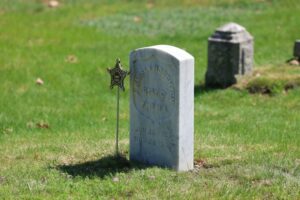
A new marble grave was installed for Josiah (Joseph) Warren Houghton, a Civil War veteran and former Grafton resident who was buried in an unmarked plot in 1908. Kjellberg located Houghton and realized he’d never been formally honored. (Photo/Evan Walsh)
In his years of research, he’s remembered the long-forgotten. In 2025, Kjellberg helped honor a Civil War veteran who wasn’t properly honored when he passed away 117 years ago. The veteran, buried in an unmarked plot in 1908, got a new marble headstone.
Then there’s his work with the town’s Vietnam War plaque. Approximately 196 veterans are honored on the town’s original plaque. Kjellberg tracked down 208 additional names, putting up a second bronze plaque. He advertised across the nation as part of the effort.
Photo/Evan Walsh
Today, Kjellberg’s database is vast: Thousands of names, their burial locations, their rank, their hometown, their company, and accolades. It’s become a living database of dead people – and something that Kjellberg hopes to pass to the next generation, if a fellow Grafton resident picks up the mantle.
“All of this information, it’s available in town in 62 different places. Now, it’s available in one. It has to be done. I was adopted here – Grafton adopted me from Day One, no questions asked. They’re dying left and right, now I’m paying them back.”
“When I die, what do I ask? Put a flag on my grave. I served.”
RELATED CONTENT:
Art Dobson: Korean War veteran, supermarket aficionado, and Rotary Club mainstay
Host of local radio show gives veterans a voice
WWII veteran celebrates 101 years at American Heritage Museum