By Janet Stoica
Contributing Writer
DOUGLAS – Rev. Julia Dunbar was ordained an Episcopalian priest at the age of 50, at an age when most people are not looking to start a new career. Now in her late 70s, she recently retired from her last congregation, the Good Shepherd Episcopal Church in Oxford.
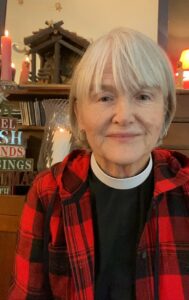
Catholic upbringing
Dunbar was raised in a Roman Catholic family but found that she wanted to learn more about the Episcopalian denomination. Unlike Catholicism, woman priests have been common in the Episcopalian church since the 1970s. She had no intention of becoming a priest but once she joined an AIDS Action Committee and was asked to meet with a prisoner in a long-term jail facility, she realized what her calling truly was. “Just visiting him in prison, I could see his suffering, and it was this that was instrumental in my becoming a priest,” she said. “Not that he was a choir boy. This part of my training in clinical pastoral care, which involved 2500 hours of working with patients, really opened my eyes to the need for counseling.”
She then worked with inpatients at Beth Israel Deaconess Medical Center in Boston and trained at Brigham and Women’s Hospital to become a chaplain. “It was such a fascinating experience introducing myself to and talking with patients to learn where they were in life,” she recalled. “Just listening and sensing them through the stage of life they were in, observing their body language.” Soon she became director of pastoral care and education at Beth Israel. She worked closely with graduate students in the program which she found gave her the greatest satisfaction as she guided and educated them.
At the age of 50, Dunbar was ordained an Episcopalian priest. She had also begun working for a philanthropy during her ordination process, and ran the charitable office while handling a large donation portfolio. She ultimately left the organization as she found she could not continue to devote the number of hours the job required while also being a priest.
Hospital work
She soon found herself handling the volunteer services department at Beth Israel. “Their pastoral care department was very small,” said Dunbar, “and soon hospital social workers began phoning me for patient assistance. Suddenly the director departed and I learned that there were many national and international applicants applying for his job. The department and patient needs were a large part of my pastoral care.” After all interviews had been held for the open position. Dunbar learned that she had been chosen as the new director.
“I met many, many people from all walks of life and that’s when I realized that we are all carrying a heavy load in life,” she recalled. “I am so grateful to have had that opportunity to meet these people and will always feel honored that they felt trustful enough to share their thoughts and words with me. I remember a call once when I’d gotten home late at night after having been with a dying patient with her son at her bedside when she passed away.”
“The floor nurses phoned me to ask if I’d return to the now-deceased patient’s room because the son did not want to leave his mom,” she continued. “It was now a few hours after the woman had passed. Her son was so broken at every level. I stayed another two hours with him and he was able to leave afterwards. I walked him to his car and saw him drive away. I then returned to the patient’s floor to check on the nurses who had compassion fatigue.” Dunbar said the challenges and life connections that she experienced in this role were “true blessings” for her. She mentioned how privileged she felt from her patient interactions.
Transition to parish churches
After working for several years in the pastoral care department at Metrowest Medical Center in the Framingham/Natick area, she was asked to fill in for other priests at their churches when they were away on sabbaticals. St. Thomas Episcopal Church in Auburn was her next assignment when parishioners asked her to join them. Then the COVID-19 pandemic happened, which shut down everything.
The rectory was sold and the church was closed quickly. Some of the St. Thomas parishioners chose to attend Grace Episcopal Church in Oxford and that’s when Dunbar learned that Grace Episcopal needed a priest and she was hired. As COVID was still rampant, most services were held outdoors and people showed up in their heavy winter coats, mittens, gloves, scarves, and woolen caps. The merged congregation members voted for a new church name and thus Good Shepherd was born. The parish grew to approximately 65 members.
As most Sunday Mass attendees are aware, there is an acute shortage of priests and most are more attracted to full-time positions. After a recent shoulder injury, Dunbar said she knew it was time to retire. She still keeps busy with her family and active with many friends she’s made along the way during her pastoral career and life’s calling.
RELATED CONTENT:
St. Matthew’s Rev. Flynn celebrates 60th anniversary
Westborough woman channels cancer experience into massage therapy career
Hudson pianist entertains audiences with the music of the silent film era