By Michael Perna Jr.
Contributing Writer
WORCESTER – In the early 1800s, a group of businessmen from Massachusetts and Rhode Island had an idea of how to capitalize on the burgeoning success of the Industrial Revolution. They decided to pursue the building of a canal that would allow for a cheaper, faster way transport goods between the rapidly developing industrial center of Worcester and Providence, Rhode Island, using the Blackstone River as a base to construct the canal.
Required 48 canal locks
After being proposed in 1790 by a group of Rhode Island businessmen, it took until 1825 before the state of Massachusetts agreed to the project and construction was begun. The river had to be cleared of rocks and rapids, and several dams had to be removed. The Blackstone Canal would eventually extend forty-six miles between the two cities. The canal was opened in 1827, with the barge “Lady Carrington” making the first trip up the canal to Worcester.
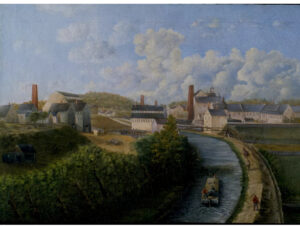
Due to the difference in elevation between the two cities – 450 feet – it was necessary to construct 48 stone canal locks to allow barges to be raised or lowered. The canal was built using shovels, spades and pickaxes, with Irish immigrants doing most of the work.
Within the city of Worcester, the canal ran from Thomas Street, through downtown, then passed just west of what is now Union Station, then down Harding Street. It then met up with Mill Brook and created an island near what is now Crompton Park – the area became known as “The Island.” This area later became home to many of the Irish workers that had constructed the canal.
Barges used for cargo
The barges used were 72 feet in length and nine-and-a-half feet wide. Pathways were constructed along the canal to allow horses to pull the barges, two for each barge, reportedly moving at about four miles per hour. Each barge could carry roughly 35 tons of cargo. The trip between the two cities would take two days and saved about $3.80 per ton of cargo, a significant improvement over the horse-drawn wagons used in those days.
The canal’s use of water sometimes created problems – ice could form, flooding could occur, or droughts could reduce the flow of water and cause the canal to close.
The canal provided the impetus for Worcester and surrounding mill towns to become an industrial hub, allowing for the cheaper and faster transportation of the goods being produced in the area. The result was the area becoming known as the “birthplace of the American Industrial Revolution.”
Replaced by railroad
Soon, industrialists in the Boston area took note of the canal’s success. Their reaction was to expand the railroad system in the area. By the late 1840s, the Providence and Worcester Railroad was put into operation, offering faster and more reliable transportation. This had an adverse effect on the canal’s operations, and the Blackstone Canal was closed in 1848.
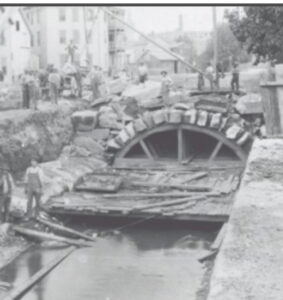
The canal itself was still used on occasion but eventually was used as a sewer. By the 1890s, it had been arched over and mostly forgotten.
Resurrecting its story
In recent years, efforts have been made to resurrect the canal’s story. The Blackstone Heritage Corridor was created and a booming business area, known as the Canal District, has attracted all kinds of stores, restaurants, nightclubs and even the Worcester WooSox baseball team, located at Polar Park.
Although the Blackstone Canal is long gone, it’s story carries on as a part of Worcester’s past.
RELATED CONTENT:
Worcester’s trolley system was once the largest in the state
Bicycle racer Marshall Walter ‘Major’ Taylor was known as the ‘Worcester Whirlwind’
Worcester State Hospital had a dark history despite good intentions