By Sharon Oliver
Contributing Writer
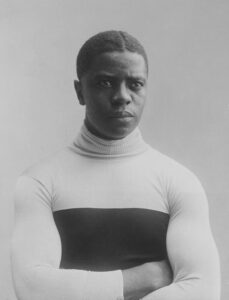
WORCESTER – Bicycle racer Marshall Walter “Major” Taylor championed strong attacks of racism all the way to the finish line. Born and raised in Indianapolis, Taylor moved to Worcester with his coach/employer/mentor and bicycle racer-turned-manufacturer Louis de Franklin “Birdie” Munger, when he was a teen. Taylor continued his budding career in bicycle racing for Munger’s Worcester Cycle Manufacturing Company. By the time Taylor turned 18 in 1896, he had already turned professional and was competing in a national racing circuit.
Set world records
In 1898 and 1899, he set world records in race distances ranging from the quarter mile to the two-mile and became the first African American to achieve the level of world champion and the second African American athlete to win a world championship in any sport, earning him the title “the first Black American global sports superstar.” Because he wore a military-style jacket while performing stunts (likely in honor of his father who served in the Union army), Taylor acquired the nickname “Major.”
Newspapers called him the “Black Cyclone,” the “Ebony Flyer,” the “Colored Cyclone,” and the “Black Zimmerman,” and the “Worcester Whirlwind.” Popular among spectators, even President Theodore Roosevelt was a fan. However, his fame came with a price.
Prejudice and discrimination
Facing racial prejudice and discrimination in a white-dominated sport, the gifted athlete wrote in his autobiography that he knew nothing of racism until the day he was refused entry to train at a local YMCA. When the circuit extended to the segregated South, local race promoters refused to allow him to compete. Nevertheless, Taylor was hailed as a sports hero in Australia and France. In his autobiography, Taylor explained that he had no other African American to offer advice, forcing him to blaze his own trail.
Three days after his Madison Square Garden race, over 25,000 spectators turned out in Taunton to watch Taylor finish second in a race. Afterwards, a white rider who alleged that Taylor had cut him off suddenly, lunged at Taylor and choked him into what one newspaper described as “insensibility.” Taylor laid unconscious for 15 minutes, causing some to believe he had died. Munger, who was at the track, managed to revive him.
In pop culture
Recently, supporters of the movie “Whirlwind,” a documentary about “Major” Taylor, gathered at the Museum of Worcester to raise money for the project. Tickets for the “friend raiser” sold for $35 with proceeds going towards filmmaker Cyrille Vincent’s goal of $1.25 million for the movie budget.
Taylor’s legacy has been noted several times in pop culture. Actor Philip Morris portrayed him in the 1992 television mini-series “Tracks of Glory.” In 2007, Nike produced the Major Taylor “premium” collection of their most iconic sneakers in a light brown/neon yellow/white colorway. That same year, SOMA Fabrications began making a set of bicycle handlebars called the Major Taylor Bar, which is a replica of the 1930s drop handlebar that was named for Taylor. In the 2013 season of the television drama series “Murdoch Mysteries,” “Tour de Murdoch” episode, Dewshane Williams played the part of Taylor.
Early demise
Taylor lived near Columbus Park in Worcester for 25 years and his daughter graduated from the Sargent School of Culture in Boston in 1925. By 1930, the celebrated cyclist experienced severe financial setbacks due to bad investments, and his Worcester home was sold to pay off debts.
He suffered a heart attack and died in 1932 at age 53 in Chicago. His estranged wife and daughter did not immediately learn of his death. Since no one claimed his remains, he was buried in a pauper’s grave.
Thanks to funds donated by Schwinn Bicycle founder Frank W. Schwinn, his remains were exhumed and reburied in a more prominent location at the cemetery The plaque reads: “World’s champion bicycle racer who came up the hard way without hatred in his heart, an honest, courageous and God-fearing, clean-living gentlemanly athlete. A credit to his race who always gave out his best. Gone but not forgotten.”
RELATED CONTENT:
Recumbent bicycles growing in popularity among older adults
Fit in her 50s, former smoker now ‘addicted’ to adventure races, ultra-marathons
Waltham man has been a competitive track and field athlete for over 50 years