By Sharon Oliver
Contributing Writer
REGION – Fans of the British drama series “The Bletchley Circle” are already familiar with the wartime code breaking women of Bletchley Park depicted in the program. The four main characters signed orders of secrecy about their work encrypting German messages during World War II. Two of the husbands thought their spouses were going to book club meetings.
College women recruited
For a few women from the New England area, deciphering German and Japanese military codes was a stark reality. Following the shocking attack on Pearl Harbor in December 1941, educated women with degrees were being recruited from colleges around the nation, including Mount Holyoke, Radcliffe, Smith and Wellesley. Several of the 11,000 female code breakers came from the Seven Sisters schools of Western Massachusetts.
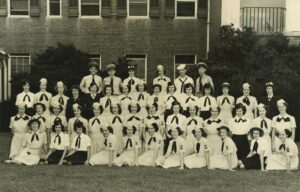
Anne Barus Seeley of Yarmouth was one such recruit. One day in the early 1940s, the Smith College history major was approached by the dean, asking her to attend a clandestine meeting in the science building. She and 10 other “A” female students were chosen for their “brains and stick-to-itiveness.” They were first asked “Do you like crossword puzzles” and “Are you engaged?” Many of the women excelled in math and foreign languages.
The Smith women attended secret training sessions in a biology lab on campus and after Seeley graduated in 1942, she was sent to Washington, D.C., telling her parents she had a job working in communications for the Navy, but she was really working in a guarded annex at American University with other code groups. Male and female code breakers arrived in Washington by the busloads, immediately increasing the city’s population.
Seeley’s job duties involved lots of mental math and one of her skills was the ability to detect simple mistakes the enemy made in their coded messages. However, Seeley insisted she was only a cog in a big machine. Her story is told in Liza Mundy’s book “Code Girls: The Untold Story of the American Women Code Breakers of World War II.”
Secret assignment
Just like the characters on “The Bletchley Circle,” the women had to keep their assignment a secret even from their families. Seeley shared that once they all arrived in Washington, they were responsible for finding their own housing. While she shared a large house with nine other women, some of the recruits had to share rooms and communal lavatories.
Elizabeth “Betty” Green Crist was another Smith graduate who worked as a code breaker. Massachusetts-born Elizabeth Reynard helped established WAVES (Women Accepted for Voluntary Emergency Services), the newly created Women’s Naval Reserve where she was the first to be appointed a lieutenant. Seeley eventually returned to South Yarmouth where she enjoyed kayaking and sailing. She passed away in 2018 at the age of 97.
Code-breaking triumphs
Thanks to code breaking, the U.S. military learned the locations of enemy ships, their payloads, and travel routes. The women deciphered an average of 126,000 enemy messages a month. Breaking German codes also led to General Dwight Eisenhower’s decision to land American troops at Normandy instead of Calais.
In 1945, it was a woman code breaker who became the first American to discover that World War II had officially ended. “The recruitment of these American women—and the fact that women were behind some of the most significant individual code-breaking triumphs of the war—was one of the best-kept secrets of the conflict,” Liza Mundy wrote in her book “Code Girls.”
To this day, many family members never knew the role their loved ones played in the history of World War II. As the late Ann Barus Seeley once said in a Smith College article dedicated to the female alum who served their country, “We have to fight this war, so I said yes to the Navy.”
RELATED CONTENT:
Quincy native Charles W. Sweeney flew both atomic bomb missions in WWII
World War II Gen. George S. Patton lived in Hamilton
80th anniversary of D-Day invasion is a somber World War II reminder