By Nance Ebert
Contributing Writer
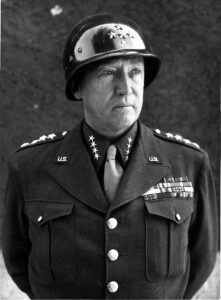
HAMILTON – Gen. George S. Patton, one of the most renowned if controversial leaders of the U.S. Army in World War II, was also a long-time resident of the bucolic town of Hamilton.
Marriage to local woman
A California native, Patton’s Massachusetts ties began when he married Beatrice Banning Ayer in 1910 in Beverly Farms. She was the daughter of wealthy Boston industrialist Frederick Ayer. In 1928 they bought a large property in Hamilton where they raised their three children, which would become known as the Patton Homestead. After remaining in the family for 85 years, it was given to the town of Hamilton by Patton’s descendants, and it’s now open to the public.
With this year marking the 80th anniversary of World War II’s end and his death, Gen. Patton’s turbulent legacy has provoked more interest than usual in his career. As a general, he displayed military brilliance but exhibited a controversial personality that made him feared by many.
Short temper and strong language
His forceful actions and short temper led to a lot of problems during his career. It is said that his vulgar speeches earned him the nickname “Old Blood and Guts” among his troops.
“Battle is the most magnificent competition in which a human being can indulge,” Patton once said. “It brings out all that is best; it removes all that is base. All men are afraid in battle. The coward is the one who lets his fear overcome his sense of duty. Duty is the essence of manhood.”
Patton was born in San Gabriel, California in November of 1885. As a young boy, he had difficulty reading and writing and even had to repeat a year at West Point when he could not pass mathematics. While he struggled with school subjects, he was a brilliant leader. He did finally graduate from the United States Military Academy at West Point in 1909.
In 1943, during the Allied campaign in Sicily, Patton humiliated and physically lashed out at two soldiers. This incident almost cost him his career, and he was severely reprimanded by Gen. Eisenhower, who he shared a friendship with that lasted two decades. Both attended West Point, with Eisenhower graduating six years after Patton.
Patton was known as a very aggressive military leader. His leadership style was embodied in some of his most famous quotes, including, “ Lead me, follow me, or get out of my way,” and “The object of war is not to die for your country but to make the other bastard die for his.”
Defeating the Nazis
Under his command, the Third Army moved into Germany and Czechoslovakia and helped defeat the last German major offensive on the western front at the Battle of the Bulge. In April 1945, Patton was promoted to temporary four-star general but was removed by Eisenhower from his leadership of the Third Army for making inflammatory remarks concerning denazification policies.
Patton died at the age of sixty on December 21, 1945, 80 years ago this month, of a pulmonary embolism following a car accident in Heidelberg, Germany. He is buried in the American Cemetery in Luxembourg.
His wife Beatrice died in 1953 after falling from a horse at the Myopia Hunt Club in South Hamilton, where she was part of a hunt with her brother and other riders. Gen. Patton was also an avid horseman, and it has been suggested that head injuries from playing polo in his youth might have contributed to his odd behavior in his later years.
Movie contributed to his legend
Patton was immortalized in American pop culture by the 1970 movie “Patton” about his life during World War II, starring George C. Scott in the title role. The film would go on to win seven Academy Awards, including Best Picture, Best Director and Best Original Screenplay.
RELATED CONTENT:
Quincy native Charles W. Sweeney flew both atomic bomb missions in WWII
Boston’s Paul Posti went from war hero to chef to celebrities