By Sharon Oliver
Contributing Writer
BOSTON – The average person of a certain age can remember Oscar Meyer’s Wienermobile commercials. However, there is one special advertising vehicle that only those from Massachusetts were privy to see. Perhaps nowhere near as sturdy as the famous Wienermobile, the WGBH Channel Two-Mobile wobbled through suburban communities from the Cape onto Route 128, destined for Boston as a fundraising gimmick during the mid-1970s.
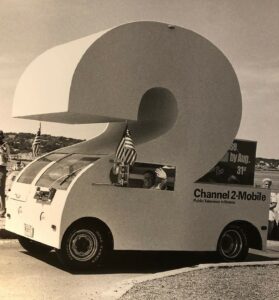
A rickety fundraising vehicle
At the time, motorists were accustomed to anything from Daimlers to dune buggies racing through the streets but only the 11 feet, 3 inches high and 6 feet wide by 10 feet long monstrosity shaped like the number two made residents do a double take. The station’s August fundraising target was set for $450,000 with faithful viewer Mrs. John Hamsel of Mansfield being the first contributor to stuff money into one of the vehicle’s currency slots.
Two people recalled their first-hand experiences to WGBH:
Deb Gibbs:
“One of my first assignments when I started working at GBH in 1975 for Chris Pullman was to find a garage to store the Two-Mobile. I remember saying to Chris – “what exactly is a 2-Mobile?”. He said come with me and I followed him out to the parking lot. He pointed to the 2-Mobile. My first thought was I’m out of here. Somehow I managed to find a garage in Allston and the 2-Mobile found a home.”
John Kerr:
“Ah, yes. The Two-Mobile was driven from the Cape to the station as a fund-raising/publicity gimmick. Chris Pullman, Design Manager, had a hand in it, as did the indomitable Sylvia Davis, and many others. It was fun and stunning to see but wobbled in the slightest crosswind and was risky to drive. We did a fund-raising shot of it crossing the reservoir between Waltham and Lincoln — a fun adventure. We did whacky stuff back then to call attention to our need for contributions. Viewers would walk up to the Two Mobile and give the driver a dollar or two and cheer it along. Wild.”
Mobile adventures
Referring to the 2-Toys, Kerr, a former WGBH Development Manager, also added, “I can’t remember how many of the wooden wonders we actually sold, nor do I recall whether the Two-Mobile actually arrived back at the studios stuffed with contributions. But it did make for some excitement and notice. One sunny afternoon, for example, we drove it nonstop through the guard gate at Hanscom Air Base, where we were supposed to have advance permission to enter. Cameraman Boyd Estus, splayed out on the roof of a chase vehicle, recorded the surprised look on the guard’s face. We thought he’d perhaps salute as we teetered through. But instead, he looked alarmed and grabbed for his phone. By the time we stopped the thing, two military police vehicles pulled up and demanded to see our permit. Today, we’d be taken to the brig.”
Indeed, the plywood frame was a sight to behold especially on windy days as pointed out by Tony Sestito on Facebook:
“I want to know where that thing went, what chassis it was built on, and how it didn’t blow over in a moderate wind while driving down the highway.”
Likewise, Myles Gordon posted, “Hope it didn’t try to squeeze the underpass on Storrow Drive.”
A relic of yesteryear, the Channel Two-Mobile along with the mini version 2-Toys prompted grins and hopes of supporters of children’s programs wanting to see the contributions flow. Even though the temperamental two-mobile was a challenge to drive and often needed the assistance of volunteers to help forge it along, the rolling advertising campaign managed to lure potential donors in town squares, shopping malls and highway rest stops during its journey.
RELATED CONTENT:
Boston-produced TV shows were pioneers in the broadcast world of the seventies and eighties
WBZ’s Dream Team represented a golden era of television news
‘Candlepins for Cash’ was a strike for Boston area television viewers