By Sharon Oliver
Contributing Writer
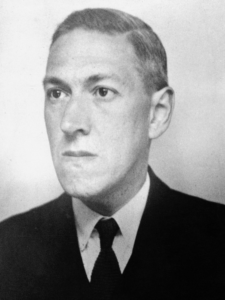
REGION – Howard Phillips “H.P.” Lovecraft may have been from Providence, Rhode Island but the famous writer of weird, horror, fantasy, and science fiction showed lots of love for the Commonwealth by setting some of his most chilling stories in the now bygone era of the state.
Story set in Boston’s North End
Case in point, his story “Pickman’s Model” is set mostly in Boston’s North End and was published in the October 1927 issue of “Weird Tales.” Apparently inspired by a building in the North End, Lovecraft wrote that when he visited the neighborhood with Donald Wandrei, he found “the actual alley and house of the tale utterly demolished, a whole crooked line of buildings having been torn down.”
The story is centered around fictional artist Richard Upton Pickman and his horrifying “deviltry and morbidity” paintings. His works are so graphically ghoulish that they result in the revocation of his membership in the Boston Art Club and his ostracism from the city’s artistic community and the story’s narrator and friend, Thurber, tells a frightening tale about his tormented pal.
Sending more chills down the spine, Pickman’s great-great-great-great-grandmother was supposedly hanged by Cotton Mather during the Salem witch trials of 1692. Interestingly, Pickman and Upton are actually old Salem names. As the story continues, Pickman vanished in 1926 (a date only given in Lovecraft’s “History of the Necronomicon”) and reappears as a ghoul in “The Dream-Quest of Unknown Kadath” (1926).
Fictional town
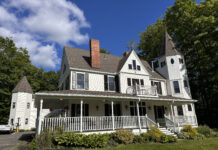
In the short story “Dreams in the Witch House,” Walter Gilman, a student of mathematics and folklore at Miskatonic University, rents an attic room in the “Witch House,” a house located in the fictional town of Arkham, Massachusetts, that is rumored to be cursed. The house once harbored Keziah Mason, an accused witch who disappeared mysteriously from a Salem jail in 1692.
Arkham Sanitarium appears in the short story “The Thing on the Doorstep” and may have been inspired by the Danvers State Insane Asylum in Danvers which appears in Lovecraft’s stories “Pickman’s Model” and “The Shadow over Innsmouth.” The story “The Dunwich Horror” implies that Miskatonic University is an elite university on par with Harvard and that both schools are the two most popular schools for the Massachusetts “Old Gentry.”
In a letter to F. Lee Baldwin dated April 29, 1934, Lovecraft wrote that “[my] mental picture of Arkham is of a town something like Salem in atmosphere [and] style of houses, but more hilly and with a college (which Salem lacks). I place the town and the imaginary Miskatonic River somewhere north of Salem, perhaps near Manchester.”
The places he wrote about in these stories and others are now known as “Lovecraft Country,” the fictionalized area of northeastern Massachusetts where many of his horror stories are set.
Profoundly morbid streak
In a 1930 letter to pulp fiction writer and creator of Conan the Barbarian, Robert E. Howard, Lovecraft tried to explain his fascination with New England as a setting for weird fiction: “It is the night-black Massachusetts legendary which packs the really macabre ‘kick.’ Here is material for a really profound study in group neuroticism; for certainly, none can deny the existence of a profoundly morbid streak in the Puritan imagination.”
Rod Serling, one of the most celebrated screenwriters and producers of weird, horror, fantasy, science fiction and macabre, appears to have also been a fan of Lovecraft and Boston. He adapted “Pickman’s Model” for an episode of “Night Gallery.” Serling’s “The Masks” episode of “The Twilight Zone” involves a family from Boston visiting their wealthy patriarch in New Orleans and stars Lowell native Milton Selzer as Wilfred Harper.
Heavily influenced by Boston-born king of macabre Edgar Allan Poe, Lovecraft has also influenced a number of musicians and the world of gaming. H.P. Lovecraft died in 1937 at the age of 46.
RELATED CONTENT:
Worcester native George Bancroft was a noted 19th century statesman and author
Mendon author chronicles tales of survival
Writing a memoir about his hometown of Quincy turned into a search for his missing father