By Colin McCandless
Contributing Writer
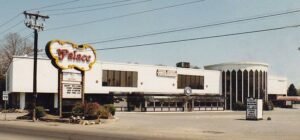
SAUGUS – To those who once experienced it either as patrons or staff, the Palace nightclub in Saugus belongs in the pantheon of New England nightclubs.
One of a kind
Entertainment mogul Russell Robbat owned the Palace, which operated from 1982-2006, with its heyday in the late ‘80s and ‘90s. One of the musicians who assisted in the opening of the Palace and helped elevate the entertainment scene there, DJ “Captain” Wendell (Wendell Edmunds), called it a “one of a kind place,” noting that it housed 15 different clubs in one building.
Edmunds first started working for Robbat in 1975 at his chain of clubs Brothers Four, which had three locations across Massachusetts. He started as a singer but eventually transitioned to turntables and spinning records.
As the name implies, Robbat and his three brothers George, Allen and Steve ran the business. This was where Robbat initially launched the multi-room nightclub concept. He continued expanding on that concept and solicited nightclub ideas from staff, said Edmunds, who currently serves as a group expert for the official Palace Nightclub Facebook page, which has 14,000 members. Robbat ultimately decided he wanted to take all their ideas and combine them into one club venue.
When the Chateau de Ville in Saugus became available in 1981, Robbat procured the square footage he needed to achieve his lofty ambitions. This facility, which had previously served as a function hall and catering event space that hosted weddings and proms, was high class and boasted a spiral staircase, chandeliers and a grand piano, remembered Edmunds, who worked there 20-plus years. It opened on Valentine’s Day, 1982.
Expansive capacity
The Palace spanned the Prince, Madonna and underground eras, and Robbat had a premier sound system and the best lighting installed, creating the ideal environment to capture the spirit and energy of these vibrant musical periods. According to Edmunds, the Palace used the same sound system as the renowned Studio 54 disco nightclub. He recalled traveling to New York City to meet with Richard Long, who designed Studio 54’s sound system, to give it a test listen. “It was perfect sound,” stated Edmunds.
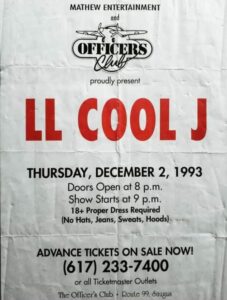
Robbat steadily built out his vision. People came. And so did the musicians. LL Cool J. Snap! Technotronic. Marky Mark. Lisa Lisa. Tavares. The Palace drew luminaries including Matt Damon, Ben Affleck, the Wahlberg brothers, members of New Kids on the Block, Marvin Hagler and legendary Celtics players like Larry Bird. “Everybody who was anybody came through,” proclaimed Edmunds.
Charlie Koehler, a former Palace employee from 1989-1996 who worked full-time in sound and lighting during the day and five nights a week as a DJ under the moniker Charlie K, said that the club, positioned along Route 99, was “perfectly situated between cities” and that its location “couldn’t be better.”
Because it operated as an event venue in the 1970s, the rooms were expansive. Koehler, who also serves as a Palace Facebook page admin, remembered that the place could hold 5,000 people. He described it as “the biggest club ever in New England.” At its height, it was regarded as one of the largest nightclubs in the country. Edmunds believes it might actually have been the largest— and would see between 12,000-15,000 people pass through its doors per week.
Something for everyone
Everyone who worked there had a colorful personality, from parking attendants to DJs. “How the place even functioned I can’t even tell you,” quipped Koehler. His introduction to the Palace came during one of its Under 21 Nights when he experienced it as a customer and then started going regularly.
According to Wicked Local, Robbat kept things fresh and constantly innovated, invariably introducing two new club themes. Robbat traveled around the world searching for novel club trends and ideas to bring back to Massachusetts. “Every 18 months he’d do something new,” said Edmunds.
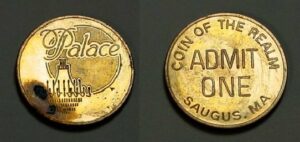
Koehler and Edmunds both recalled how each room in the Palace offered something different; there was disco, reggae, Top 40, a heavy metal club, a Cowboys Club, the Officer’s Club, a male exotic dancing show and later, a Latin room and a hip-hop room would be added. “There was something for everyone in that club,” asserted Edmunds. “It was like Disneyland.”
Koehler said that to call Robbat a visionary in the club scene “would be an understatement.”
“He had no problem dropping a lot of money on a concept.”
He also characterized the Palace’s general manager Chris Scott, who served as its GM for the club’s entire existence, as a “larger-than-life guy in every way, shape or form.”
“Chris was an absolute trip.” Koehler, who left the Palace in 1996 to form his sound and lighting company TKO Sound, said he still keeps in touch with some of the management today.
Periodic renovations
Another thing Palace management would periodically do is renovate the main room and change the décor. Koehler recollected that the second main room renovation was the Bahama Beach Club, referred to as the BBC, replete with giant fake palm trees, trucked-in sand, a beach volleyball court, surfboards that doubled as tables, thatched roofing and piles of coconuts. It may have been campy, but it was Koehler’s favorite club. “It captured the end of the ‘80s and the first couple years of the ‘90s. It was such a fruitful, happy time,” he reminisced. Edmunds remembered that the BBC was a gigantic room with five or six bars and massive bass speakers that people would dance on.
The Palace featured everything from celebrity singers and a mechanical bull to a foam pit filled with bubbles and a UFO that could fit a person inside it. This mobile spaceship came out of the wall and could lower singers over the audience. “Every corner of that place had something going on,” recounted Koehler.
Violence led to demise
A series of violent incidents, including a fatal stabbing on New Year’s Eve 2001 in the Officer’s Club, ultimately led to the Palace’s demise. Edmunds recollected that this was a sad and tragic incident but added that the town had been trying to close the Palace down for a while by this point because they “always thought it was trouble.” “But it was well run,” he asserted.
In 2006, the building was auctioned off and Robbat sold the 22-acre property to Lowe’s Home Improvement store, according to Wicked Local. The Palace itself may be physically gone, but it’s certainly not forgotten.
Fond memories endure
Former staff commemorate the club by hosting an annual Palace Party Reunion welcoming past patrons, employees and friends. DJ Eddy K launched the inaugural party. Since then, it’s been either him, Edmunds or others who have coordinated it. Additionally, the “Men in Motion” male revue show that the Palace started remains in in business today.
On the Palace’s Facebook page, the fond memories endure as people post pictures and “share old war stories,” as Koehler put it.
“There will probably never be another place like it,” reflected Edmunds.
RELATED CONTENT:
Spit was a Boston nightclub with an attitude
The Channel nightclub was one of Boston’s top live music spots in the ’80s
Boston’s legendary rock club ‘The Rat’ is still remembered fondly