By Matt Robinson
Contributing Writer
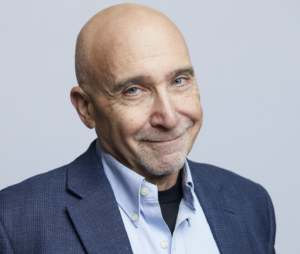
REGION – Chuck Goldstone is many things to many people. A self-described author, entrepreneur, radio commentator, astute observer, insight extractor, purveyor of mockery, story muscleman, and mensch, he has served as a mentor to numerous individuals.
In conversation, he shares countless stories and lessons learned that can change many of your personal and professional perspectives. According to Goldstone, that is apparently the point.
Attracted by startup community
Though he grew up in Pittsburgh, Goldstone has made his home and his mark in Boston for many years. Originally attracted by the prospect of attending graduate school at Boston University, Goldstone stayed in Boston to be part of the thriving startup community here.
“I love working with the startup community,” he smiled, suggesting that he provides “more than pitch” to his students, colleagues, and clients.
By advising people to focus on their interlocutor instead of their ego, Goldstone encourages compassion and connection.
“I’m trying to help people simplify their message,” he observed, noting this as the basis for his latest course, Teaching Technical Experts to Speak to Mere Mortals. “It helps people explain complexity in a simple way. Not just how things work, but why they need to exist. Not just what it does, but what it can do for people.”
As with corporations, so too with corporeal beings, Goldstone said.
“I meet hundreds of people each year,” Goldstone explained, “and… often the first question is…’What do you do?’”
While we may all be familiar with this potentially pedantic query, Goldstone suggests that we may still need more practice with it.
Seeing the big picture
“A lot of us answer it wrong,” he maintained. “We talk about how we do things, but do not give the big picture first, and we lose people because we are not answering from their perspective.”
According to Goldstone, when someone asks you, “What do you do?” what they actually want to know is, as he puts it, “Why do you deserve to be in the cosmos?… Are you doing something no one else can do?”
By considering what may often seem like a simple question as a Star Trek-like cosmic query, Goldstone suggests that we can learn about ourselves and make more impactful connections with others.
Speaking of impactful connections, though he has worked with such major corporations as Keurig and Pepsi, when asked where he feels he has had the most impact, Goldstone talks about the weekly roundtable that he has been hosting every Wednesday since the pandemic.
“In 2020, we realized the world was changing,” he recalled, “and not for the better.”
Realizing that the pandemic would potentially limit his opportunities to connect people, Goldstone seized the latest technology and bent it to his will.
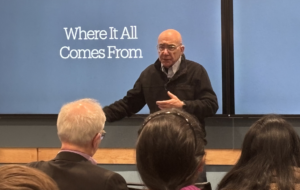
“I originally pulled together a group of 20 to do what we thought would be temporary,” he explained. “We met one Wednesday and agreed to meet the next Wednesday, and eventually it grew and became something very different.”
For the past six years, Goldstone and his international cohort have gathered around their respective screens to continue a conversation that has had both personal and global implications.
“It is people supporting each other and meeting each other,” he said simply. “We have lost count of the meetings, referrals, job leads, and other things that have resulted.”
Though the group continues to grow each week, Goldstone has never charged anyone to participate.
“People ask me if I am monetizing it, but I ask, ‘What is the opposite of monetizing?’”
A varied career
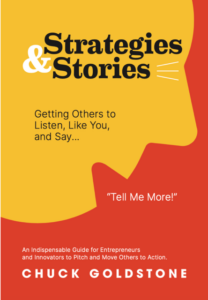
Another way that Goldstone has been able to reach people far and wide is through his writings, including his humor book, “This is Not a Toy,” and his entrepreneurial guide, “Strategies and Stories: Getting Others to Listen, Like You, and Say ‘Tell Me More!’” The latter book has been adopted by colleges and business incubators and accelerators.
“It’s based on how I connect people and how I learn connection through conversation,” he explained of the story-forward offering.
So while Goldstone has plenty to brag about, including a successful career in broadcasting that was followed by a successful publishing career and appointments to teach and advise at venues all over the world, he still prefers to focus on the other person in the conversation instead of himself.
“You are not who you think you are,” he observed. “You are not even who you are. You are who others think you are, and it is your responsibility to control that perception. You need to differentiate yourself from everything they could confuse you with. If what makes you better is how you connect, that is your differentiation.”
While this may very well be the secret to his success, he is more likely to suggest that it is the secret to yours.
Making connections
“We do not make decisions based on similarities,” he concluded. “We make connections based on similarities, but we make decisions based on differences. So when you clarify what makes you different, that is what makes you resonate and increases the odds of being chosen.”
Though many come to him with what they see as problems and challenges, as more people choose to engage and learn with Goldstone, he actually has a very optimistic view of the future.
“What I have seen is that people really want to support each other,” he observed. “I only see things getting more supportive!”
RELATED CONTENT:
Former Boston broadcast journalist trains others to be top communicators
‘Chronicle’ producer has balanced second career as alternative rock musician