By Michael Perna Jr.
Contributing Writer
WORCESTER – One hundred years ago, on March 16, 1926, the world entered the modern rocket age thanks to Worcester native Robert H. Goddard. He had been experimenting with rockets for over a decade, but it was on that night on a farm in Auburn that the first liquid-fueled rocket shot into the night sky.
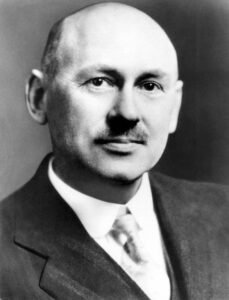
Photo/Wikimedia Commons/NASA
Childhood curiosity
He was born in Worcester, Massachusetts on October 5, 1882. As a little boy, Robert Hutchings Goddard was considered what was known in those days as “sickly” and ended up missing a great deal of time from school. This did not stop him from having a great deal of interest in the ways of science. For instance, at the age of five, his father explained how he could generate static electricity on the family’s carpet.
Young Robert then had the idea to try to charge a battery by scuffing his feet on a gravel walk, in hopes the battery would help him jump higher. He abandoned his experiment after his mother warned him that if he was successful, he might “go sailing away and might not be able to come back.” In another experiment, he mixed chemicals in the house, causing a smoky explosion.
When he read a newly published book, H. G. Wells’ “The War of the Worlds,” which described a Martian invasion of the earth, his fascination with space flight was born. When he was 17, he had an experience that he later would describe as his “greatest inspiration,” which he described in his very detailed diary that he kept for many years:
“On this day I climbed a tall cherry tree at the back of the barn…and as I looked toward the fields at the east, I imagined how wonderful it would be to make some device which had even the possibility of ascending to Mars.…I was a different boy when I descended the tree from when I ascended. Existence at last seemed very purposive.”
Academic career
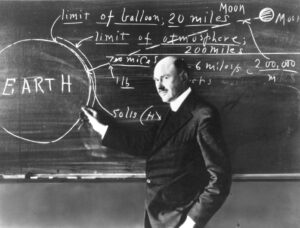
He went on to obtain his bachelor of science degree from Worcester Polytechnic Institute, then earned his master of arts degree in 1910, then his doctorate degree in physics from Clark University in 1911. He then became a part-time instructor and research fellow at Clark, where he also pursued his interest in rocketry research.
He was described by his colleagues as shy and reserved, which they considered to be detrimental to being a good professor.
Photo/Wikimedia Commons/NASA
His first experiment involved the launch of a powder rocket, which he launched during an evening in the fall of 1915. The launch was noisy and bright enough that it alarmed the college’s janitor – Goddard had to reassure him that nothing was wrong. After that time, he moved his experiments to an inside laboratory.
He eventually came up with plans to produce a liquid-fueled rocket. By this time, he had been noticed by organizations such as the Smithsonian Institution, the National Geographic Society, and the Aero Club of America.
He performed tests on a military rocket launcher, later to become known as the “bazooka” during World War I, however the war ended before the weapon was put into use.
Funding for experiments
His experiments continued, with him eventually receiving a research grant of $5000 from the Smithsonian. Clark University also provided some funds for his work.
By 1926, he was ready to test the world’s first liquid-fueled rocket. The launch took place on March 16 in Auburn at what he described as “Aunt Effie’s farm” – today the site is a National Historic Landmark known as the Goddard Rocket Launching Site. The launch was only partially successful; however, Goddard went on to make improvements to his design.
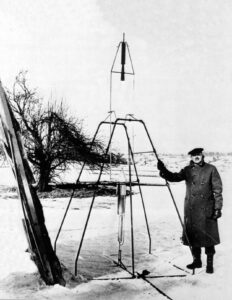
From that time on several nations went on to utilize the same type of propulsion system in both military and space flight rockets, continuing right up into the present day.
Robert Goddard became known as “The Father of Modern Rocketry.” He continued his work with rockets right up to and through World War II. Sadly, he contracted tuberculosis, then was diagnosed with throat cancer. He died in August 1945 and was buried at Hope Cemetery in Worcester.
As the world remembers Robert Goddard’s first rocket launch, there will be several events to note the centennial of the achievement, including some at Robert Goddard Park in Auburn.
More information about the celebratory events can be found at goddard100th.org.
RELATED CONTENT:
Green Hill Park is the ‘crown jewel’ of Worcester
‘The Whistler’ was a Worcester legend
Speedy’s Drive In was an iconic Worcester destination