By Sharon Oliver
Contributing Writer
BOSTON – Con artist Victor Lustig “sold” the Eiffel Tower (twice) and scammer George C. Parker “sold” the Brooklyn Bridge to immigrants. Enron famously hid debts off balance sheets and Sam Bankman-Fried has been convicted of massive crypto fraud. The list of cheaters, hustlers, scoundrels and swindlers is remarkably long.
Nevertheless, one of the biggest fraudsters who became a household name was Bernie Madoff. The financier and one time chairman of the Nasdaq stock exchange bilked dozens of people out of an estimated $65 billion totally, implementing the largest known Ponzi scheme in history.
Start as bank teller
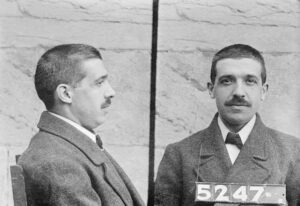
However, Madoff was not the originator of the scheme. That dubious honor belongs to a dapper charlatan from Boston. Born Carlo Pietro Giovanni Guglielmo Tebaldo Ponzi in Parma, Italy, in 1882, Charles Ponzi arrived in Boston in 1903 with $200 and hopes of making a fortune. And a fortune he made.
Ponzi found employment working as a teller at the Bank Zarossi but was soon out of a job after the bank failed and its founder high-tailed it to Mexico following the bank’s scandal. Ponzi spent three years in federal prison after getting convicted for forging a $423.58 check, then stumbled upon a get-rich scheme by convincing investors into buying an International Reply Coupon, promising returns of 50 percent in 45 days, or 100 percent in 90 days. Before long, nearly 20,000 investors handed him $10 million.
Photo/Wikimedia Commons
Hauling in approximately $250,000 a day, Ponzi purchased a mansion in Lexington and tooled around town in a chauffeured limousine. Neal O’Hara of the Boston Traveler wrote in 1920, “If five-spots were snowflakes, Ponzi would be a three-day blizzard. This baby can turn decimal points into commas on almost any bankbook.” He even took over the bank that rejected his loan application and bought a brokerage firm just to fire his former boss the next day.
Scheme ends
His con came crashing down on July 26, 1920, after the Boston Post reported 160 million international reply coupons were needed to cover investments in Ponzi’s scheme. The problem was that only 27,000 were in circulation and hearing this made a panicky crowd of investors surround Ponzi’s office demanding their money. Ponzi told them not to worry as he passed out coffee and donuts along with $2 million. However, Massachusetts Attorney General J. Weston Allen released a statement of contradiction stating there was little to support Ponzi’s claims of large-scale dealings in postal coupons.
Ironically, Ponzi’s own publicity agent claimed his client was a financial idiot who couldn’t even add and that his investment scheme amounted to nothing more than robbing Peter to pay Paul. Ponzi’s scheme brought down five banks and investors were practically wiped out. He was charged with 86 counts of mail fraud. Facing life in prison, he served a mere three-and-a-half years.
By comparison, Bernie Madoff’s 2008 scheme cost his investors about $18 billion, 53 times the losses of Ponzi’s scheme, which was about $20 million in 1920 dollars (approximately $314 million in 2024 dollars).
Final years
Charles Ponzi spent his remaining years facing criminal charges and further prison time to include 10 counts of larceny in 1922, and after being released on bail he fled to Florida where he promised investors tiny tracts of land (actually swampland) with 200 percent returns in 60 days.
Ponzi tried to flee the country as a crewman on a merchant ship bound for Italy, but a shipmate got word to a deputy sheriff, who followed the vessel to its last American port of call in New Orleans and placed Ponzi under arrest. Ponzi’s pleas to Calvin Coolidge and Benito Mussolini for deportation were ignored and he was sent back to Massachusetts to serve out his seven-year prison term.
Living in poverty and plagued by poor health (weakened by a heart attack, nearly blind and a paralyzed left arm and leg), Charles Ponzi died in a charity hospital in Rio de Janeiro, Brazil in 1949 at the age of 66.
RELATED CONTENT:
Brookline big-league prospect was recruited as hitman for Fidel Castro
Piper Kerman: From ‘Orange Is the New Black’ to Justice Reform Advocacy
First-ever recorded Mafia induction ceremony occurred in Medford