By Brett Peruzzi
Managing Editor
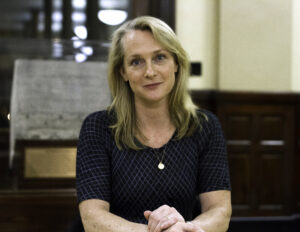
SWAMPSCOTT – Piper Kerman had a privileged upbringing in this affluent North Shore town. But it didn’t stop her from ending up as an inmate in 2004 in the federal prison system after pleading guilty to charges of money laundering and conspiracy to commit drug trafficking.
What that experience did do for her was inspire her to write a best-selling memoir about her 13-month stint in prison, “Orange Is the New Black: My Year in a Women’s Prison,” which later became an award-winning television series on Netflix.
Photo/Wikimedia Commons
Recognizing the humanity of inmates
“Part of my goal in writing the book … and allowing it to be adapted, was for more people to recognize the humanity of people in prison, or in the criminal justice system,” Kerman told The Dickinsonian, the Dickinson College student newspaper, in a 2018 interview. “We want to have a criminal justice system, wherein if someone we love ends up in that position, we wouldn’t fear for their lives, we wouldn’t fear for their safety, we wouldn’t fear for their sanity,” she explained. “We wouldn’t ever want someone we love to go into prison or jail and come out in worse shape than when they went in, but that’s exactly what happens far too often.”
So how did the 56-year-old graduate of Swampscott High School and Smith College find herself incarcerated? In 1993, while she was in her early 20s, she participated in a drug-smuggling operation. She transported a suitcase of cash from Chicago to Brussels, a crime she was later implicated in by an ex-girlfriend. Although she ended her criminal involvement in the mid-1990s, the FBI investigated and paid her a visit in 1998. Charges were brought and she eventually entered a guilty plea to laundering money for a drug ring.
Kerman was sentenced to 15 months, and served 13 months in the Federal Correctional Institution in Danbury, Connecticut, between 2004 and 2005. Five years later in 2010, her book about her prison experience was published to widespread acclaim. One point Kerman makes clear is that the United States is an outlier in the number of people who are incarcerated.
A prison nation
“We are a prison nation in comparison with all other nations in the world, by far, and historically you can’t find another society that has ever chosen to do what we’ve done to ourselves,” she observed in The Dickinsonian interview. “The United States incarcerates more of its own people than any society in human history has ever done. We can’t really claim to be the land of free where in fact we’re the land of the incarcerated. And of course, women have been the fastest growing part of the prison system for decades now.”
Kerman’s approach in her book was more analytical than sensational, despite the drama that is portrayed in the Netflix series. She uses her editorial lens to examine systems — incarceration, policy, inequity — rather than just recounting interactions between individuals.
In the book, she is very aware that she entered the federal prison system with many advantages, including an elite higher education, support from her family, as well as the financial and cultural capital that comes with her background. Indeed, one of her memoir’s central themes is how privilege operates inside and outside the justice system.

Photo/Courtesy of Netflix
“When we think about crime and punishment and safety, one of the most interesting concepts is the idea of desistence,” Kerman noted. “We get a lot of focus on external factors controlling crime or determining safety, but if someone is involved in a harmful behavior, we want them to be able to desist from doing what harms them or what harms other people,” she said. “Story and narrative plays a really strong role in a person’s ability to desist. The story of their past and the story of who they are in that moment, has to change for them and they have to be able to develop a new story going forward, an authentic story and something that they want for themselves.”
Kerman talks in her book about how prisons fail both inmates and society at large. “The public expects sentences to be punitive but also rehabilitative; however, what we expect and what we get from our prisons are very different things,” she added. “The lesson that our prison system teaches its residents is how to survive as a prisoner, not as a citizen — not a very constructive body of knowledge for us or the communities to which we return.”
Post-prison life
Following her release from prison, Kerman married writer Larry Smith and began writing her book. Kerman and her husband and son lived for several years in Columbus, Ohio where she taught writing classes at the Marion Correctional Institution and the Ohio Reformatory for Women in nearby Marysville, Ohio. After the success of her book and the creation of the Netflix series, she served as a consultant on the show for its seven-season run, reading scripts and providing feedback to ensure the prison portrayed on the show was realistic. She and her husband had a cameo appearance in the show’s final episode, portraying visitors in the prison’s visiting room.
Kerman and her family now live in Berkeley, California, She is a writer and speaker focusing on women in the criminal justice system, re-entry, and the importance of arts in prisons. Kerman serves on the board of directors for the Women’s Prison Association. She has been working on a second book, regarding her experiences teaching in the prison system. She was awarded the ‘Humanist Heroine of the Year Award’ from the ‘Humanist Hub’ group at Harvard University.
RELATED CONTENT:
Mendon author chronicles tales of survival
Cambridge author drew inspiration from unique sources
Massachusetts is the perfect home for ‘Wicked’ author Gregory Maguire