By Michael Perna Jr.
Contributing Writer
SHREWSBURY – The history of crew racing on Lake Quinsigamond originally dates back to the years before the Civil War, when different colleges competed there. The “Lake” was an ideal spot for this particular sport, being a long, narrow venue. At that time it was also bisected by what was known as “The Causeway,” all of which made it an ideal place for spectators to cheer on their particular crew teams. Although the Civil War paused racing, things picked back up in the years following.
A number of boat clubs formed around the Lake, such as the Quinsigamond Boat Club, the Lakeside Boat Club, and the Wachusett Boat Club. The Wachusett Boat Club in particular won a number of awards, including several at the National Regatta in 1895. In 1897, 18-year-old “Ned” Ten Eyck, of the Wachusett Club, won the Diamond Sculls at the Royal Henley Regatta in England.
Shrewsbury police officer
Although crew racing dwindled for a few years, it was reborn in 1937, mostly due to the efforts of Kenneth Burns, who was a Shrewsbury police officer at that time (he later became the chief of the department). Burns was an accomplished sculler in his own right, one of the fastest in New England. He won every race he entered from 1922 to 1925 and in 1925, he and Fred Haas won the Senior Double Sculls event and set a new lake record with a time of 9 minutes, 13 seconds.
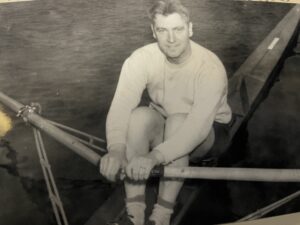
In 1937, he formed a crew racing team at Shrewsbury High School, this in spite of a lack of funding and having no crew racing shells. The boys learned the sport using planks as makeshift boats. Burns succeeded in raising funds for the team, getting assistance from local businessmen and sports enthusiasts. Before long, the team had two old eight-oared shells and a set of oars, donated by Ivy League colleges that no longer used them. One of the shells, contributed by Yale University, was known as the “Dipsy Doodle” because it was so warped, according to the late Barbara (Burns) Caron, Coach Burns’ daughter.
Numerous awards
Under Coach Burns’ supervision, the SHS crew team went on to win numerous awards, starting with winning the first race they ever entered. They then went on race in the 54th annual regatta of the New England Amateur Rowing Association held at the Charles River basin, in which they won a stunning upset victory against several well-established crew racing clubs.
They then went on to the National Regatta in Buffalo, New York, where they faced the Lafayette High School crew from Buffalo. In an extremely close finish, Shrewsbury was first declared the winner, then had the ruling overturned with Lafayette said to have won by one-fifth of a second.
In 1939, despite having only three years’ experience, they won the Junior Schoolboy Championship in Boston, despite being rated as underdogs.
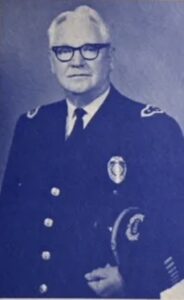
Coach Burns was instrumental in bringing many rowing activities to Lake Quinsigamond over the ensuing years, including the Middle States Regatta in 1950, the National Regatta in 1951, the Olympic Trials in 1952, and the Eastern Sprints in following years, with many rowing activities continuing to the present day.
Family tradition
In the mid-1970s, Coach Burns encouraged his daughter, Barbara (Burns) Caron, who was a physical education teacher at Shrewsbury High School, to start a girl’s crew team, which she did. A few years later, Burns started training his granddaughter, Pamela (Caron) Krause in the sport. When Barbara Caron retired in 1994, Pam took over as the coach.
Coach Burns himself, after sixty years of involvement in crew racing on Lake Quinsigamond, passed away in 1982. His many outstanding accomplishments in this field resulted in the newly constructed Route 9 bridge over Lake Quinsigamond being named after him in 2015. Memorial panels detailing his dedication to the sport are in place at either end of the bridge.
RELATED CONTENT:
Shrewsbury Friends’ Lake Quinsigamond Kayaking Adventure
White City Amusement Park in Shrewsbury: A Nostalgic Look Back
Remembering Spag Borgatti’s Legacy: 30 Years Later