By Michael Perna Jr.
Contributing Writer
WORCESTER – Back in 1870, Dr. Albert Wood, who was serving as Worcester’s “City Physician,” saw the need for a hospital that would serve the city’s poor population. The hospital would be able to serve twenty patients. His proposal gained support, and by May 1871 it was approved, with the annual estimated cost of running the hospital set at $10,000.
Former mansion
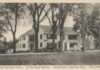
Space was leased in the former mansion of one Abijah Bigelow, located at the corner of Front and Church Streets. There were enough rooms for eight to ten patients. The hospital opened on October 26, 1871, and Dr. John Parks was named as the first superintendent, with one Miss M. A. Hales as the matron. The rest of the staff consisted of one male and one female nurse, a night watchman, a cook and her assistant, and a laundress – quite a far cry from the staffing at any modern hospital. The superintendent’s salary was to be $700 per year, with the matron earning $25 per month.
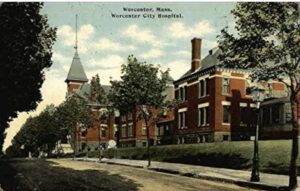
After the first year of operation, it became apparent that more space was needed, Mr. George Jacques, one of the hospital’s trustees, left a good-sized parcel of land on Jacques Street to the city, with it being intended to use it for a hospital. This proposal was pursued and a new hospital was built, opening in 1881. The new facility consisted of two wards, each capable of treating forty patients.
By 1883, a training school for nurses was established. This consisted of a two-year program for “women desirous of becoming professional nurses.” The first class of nurses graduated in January 1886. A building located at the rear of the hospital was acquired in 1893 and converted into a nurse housing.
Scandal and expansion
A scandal involving the hospital’s long-time superintendent, Dr. Peabody, occurred in 1902, when he was arrested for embezzlement of hospital funds, which he spent on himself and his relatives. He resigned from his position.
By 1904, the city had appropriated a considerable sum of money, and the hospital was greatly expanded, with a large number of buildings, including an outpatient building, a chapel, a pathological building, an isolation building for housing patients with contagious diseases, a kitchen building, and additions to several existing buildings.
Following a series of other improvements, the Jacques Memorial Building was opened in 1937, increasing the hospital’s patient capacity to 475.
During the ensuing years, the hospital gradually changed from its original purpose of serving the city’s poor and underprivileged into a facility that treated patients from all social classes.
Today, only a few local residents have recollections of being treated at the hospital or working there. One, Sandra (McKee) Perna, does recall her days of volunteering at the hospital in the early 1970s as what was known as a “candy-striper.” She and several of her friends would help out at the hospital during those times. The name “candy-striper” came from the red and white striped uniforms the girls wore. “We thought we were really something, helping out at the hospital.” she recalled.
Decline and closure
As more and more hospitals started serving the local area, City Hospital’s patient population began to decline. By 1988, what had become a 271-bed hospital had an occupancy rate of only 39 percent. The resulting financial difficulties forced Worcester City Hospital to close in 1991, after serving the residents of Worcester and the surrounding area for 120 years.
The hospital facilities were turned into what is known as the Family Health Center of Worcester, which is a non-profit organization, located at 26 Queen Street.
RELATED CONTENT:
Hotel Bancroft was once Worcester’s premier lodging and event destination