By Sharon Oliver
Contributing Writer
COHASSET – Somewhere around the late 1890s, stage actor and Leicester native William H. Crane invited Lewis Williams, co-owner of Chicago’s posh saloon Williams & Newman, to his seaside estate in Cohasset, a summer resort for wealthy Bostonians and popular with actors and yachtsmen. Crane was well familiar with the fancy cocktails served at the respected Williams & Newman and wanted to impress his friend. After all, Williams’ partner, Tom Newman, was a renowned mixologist.
Attempt to impress
While at the South Shore soiree, Williams overheard other guests discussing the superiority of New England’s rum punches. He immediately wired Newman, asking him to concoct a rum cocktail to wow Crane’s friends, writing it should “surpass anything ever before imbibed by any living soul.” Twenty-four hours later, Newman shipped a cask of his new creation by railcar and bound for Cohasset. The cocktail was a hit, and a legend was born among the elites at the estate, and Newman was declared the “king of blenders.” When Newman sent a telegram asking what to call the new drink, Williams replied with one word: “Cohasset.”
Now famously known as Cohasset Punch, the drink combined rum, sweet vermouth, wine, several ingredients Newman kept secret and was served in a chilled champagne glass over a brandy-soaked peach slice. When Lewis Williams returned to Chicago, he and Newman began serving the punch in their saloon. Chicagoans drank so much of it that a 1902 article in Bonfort’s Wine & Spirit Circular printed: “What the mint julep is to the South, Cohasset Punch is to Chicago.”
Bottled product
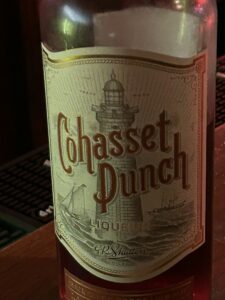
In 1899, the business partners began selling the drink in bottles, using an illustration of Cohasset’s iconic Minot’s Ledge Light on the label. The two boats pictured on the bottles’ label are the single-masted “catboat” Chloe and the single-screw steam yacht The Senator, both owned by William H. Crane.
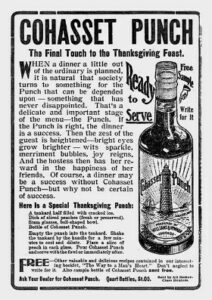
In 1938, a letter appeared in the Chicago Tribune describing the feeling one has after three or four glasses of Cohasset Punch. “[A] pleasant mellowness steals over you, your imagination glows, you discover humor you never possessed. Then suddenly you push your chair back to stand up, and lo, your legs are merely attached to your body for appearance’s sake!”
Although the cocktail remained a favorite for decades (until the 1980s), its popularity did wane. In 2024, the Cohasset Punch brand was resurrected by a Chicago-based cocktail historian using historical accounts of the flavor and ingredients that once described the Windy City’s signature drink. Greg Shutters, a graphic designer, was working on a menu design concept in 2019 while studying old cocktail menus from Chicago during the 1930s and 1940s. Shutters said, “I kept seeing the name Cohasset Punch, but I had no idea what it was. From what I can tell, Cohasset Punch was a huge thing in Chicago in the early 1900s and then again just post-Prohibition.”
Region’s rum heritage
There was a time when rum-making was the largest and most lucrative industry in colonial New England. Before the American Revolution, every man, woman and even child in the area drank an average of 3.6 gallons of rum every year.
Many Puritans had liquor stills in their homes to make rum for medicinal purposes and to offer to guests. By the middle of the 17th century, Massachusetts had more than 60 distilleries. By the 19th century, New England’s rum business went into sharp decline after the British cut off access to cheap molasses and most New England distilleries closed.
RELATED CONTENT:
Moxie, the oldest soft drink in the country, got its start in Massachusetts
Jimmy Buffett’s “Boat Drinks”: The True Boston Story Behind the Song
Parker House hotel is birthplace of Boston cream pie and other food creations