By Michael Perna Jr.
Contributing Writer
REGION – Located in the towns of Stow and Hudson, Lake Boon has a long and interesting history, dating back to the 1600s. The lake actually consists of four different basins, which are connected by narrow waterways. The total area of the basins is approximately sixty-three acres, with the average depth being about eleven feet, although at some points it is as deep as twenty-three feet.
Only one portion of the lake is entirely with the town of Stow, this being the largest basin. The second basin is roughly half as large as the first one and is located right between Stow and Hudson. The other two basins are smaller, more shallow and harder to navigate because of plant growth.
Named after early settler
The largest basin was named after one of the first two settlers in Stow, Matthew Boon, who came to the area from Charlestown. He was reportedly killed by Native Americans on February 14, 1676. The basin was named Boon Pond after him and a monument was erected in his memory in 1883.
It was purchased by a man named Amory Maynard in 1847, who had a dam erected in order to increase the water supply so as to power what was known as the Assabet Woolen Mill in Maynard. At this time the name was changed to Lake Boon. The addition of the dam caused the water level in the lake to fluctuate significantly. Later on, the mill was converted to coal power, which then allowed the water level to stabilize throughout the year.
Visit from Thoreau
One notable visitor came to the lake on September 4, 1851 – Henry David Thoreau. He made note of the visit in his journal:
“And now we leave the road and go through the woods and swamps towards Boon’s Pond, crossing two or three roads and by Potter’s house in Stow; still on east of river…Part of it called Boon’s Plain. Boon said to have lived on or under Bailey’s Hill at west of pond. Killed by Indians between Boon’s and White’s Pond as he was driving his ox-cart. The oxen ran off to Marlborough garrison-house. His remains have been searched for. A sandy plain, a large level tract. The pond shores handsome enough, but water shallow and muddy looking. Well-wooded shores. The maples begin to show red about it. Much fished.”
Tourist attraction
By the end of the nineteenth century, Lake Boon had become a popular tourist attraction. Visitors came from all over the area, including Boston, by way of two railroad lines. This increase in tourism resulted in the area becoming more developed – a hotel, numerous clubs, stores, and churches, in addition to two post offices were built. A steamship, named the “Cleo,” was put into service, which allowed people to visit the various attractions. The Cleo was replaced by a gas-powered ferry named the “Princess” in 1910.
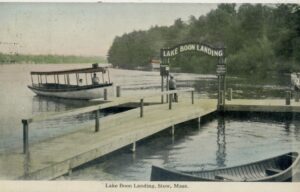
After automobiles became more prolific in the 20th century, people began to travel more extensively, and the number of visitors to Lake Boon dropped off. The hotel closed and many private residences were built on the shores of the lake. A semi-public beach was eventually opened, named Pine Bluff. This is located on the shore of the north basin in Stow, and features swimming, picnic tables and grills, a playground and sports fields.
The Lake Boon of today is much different than it was so many years ago, in the days when it was frequented by Native Americans and Thoreau, being mostly lined with private homes, although the Pine Bluff Beach has endured.
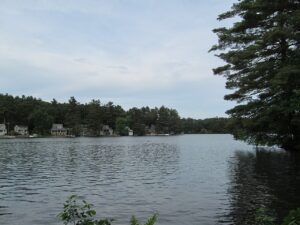
Photo/Wikimedia Commons/John Phelan
RELATED CONTENT:
Shrewsbury friends enjoy Lake Quinsigamond ‘adventure’
The mid-Cape region has plenty of opportunities for warm weather fun
Hudson man paralyzed over 30 years ago says it was a blessing