By Sharon Oliver
Contributing Writer
REGION – In December of 1929, Maine floatplane pilot William Wincapaw started a time-honored tradition. He loaded his plane with candy, coffee, newspapers and other items and dropped them from his cockpit as he flew over New England lighthouses. As time went by, he and his 16-year-old pilot son William Jr. were joined by a young Winthrop high school teacher named Edward Rowe Snow who was an expert aerial photographer of his favorite subject, lighthouses.
Widely known for his stories of pirates and maritime history, Snow wrote over forty books, some of which were staples in New England homes. The author of more than 100 publications, mostly about New England coastal history, Snow became famous as a historian of the New England coast and was a popular storyteller, lecturer, preservationist, and treasure hunter after his 1935 publication of the book “The Islands of Boston Harbor.” Another classic is his “Storms and Shipwrecks of New England,” which was published in 1943.
The face of Flying Santa
Sadly, Wincapaw was killed in a plane crash in 1948, having suffered a heart attack while taking off in Maine. Even though Snow was not a pilot, he was able to take over primary responsibilities of the project, thanks to having no trouble finding others to fly him around and he quickly became the face of the Flying Santa.
According to his daughter Dolly Bicknell, who accompanied her father on flights from being a toddler through her teens, “Dad loved being Flying Santa. He did it for 40 years and enjoyed dropping presents to the keepers and their families. He and my mother would assemble all the gifts in the basement of our home for weeks leading up to Christmas. He paid for about 90 percent of it.”
Those gifts largely consisted of products donated by New England sponsors and included everything from coffee, tea, Gillette razor blades, rubber balloons, chewing gum, dolls and pen and pencil sets. The plane would circle the towers three times: once to signal, once to make the drop, and a third time, to check the drop.
A Christmas flight in 1940 would be the beginning of Anna-Myrle Snow accompanying her husband in spreading Christmas cheer. This was also the first year that Wiggins Airways became involved, providing the charter and their pilot Charles Cowan. Over the next 60 years, the company would be the provider of a number of “sleighs,” from prop planes to helicopters.
In 1941, Rowe Snow and pilot Al Leckscheid, took off on Christmas morning to drop packages in over 35 locations. Aside from being the Flying Santa, Snow is fondly remembered for his writings and weekly radio show as well, evident by the following Facebook remarks.
Chris Connolly wrote:
“Amazing man for his knowledge of Boston Harbor history. He was called the Flying Santa, dropping off Christmas presents to the lighthouse keepers.”
Louise Carella chimed in:
“Loved listening to him on the radio!”
Joe MacDonald recalled:
“Growing up on Humarock Beach in the 60s, he was quite the celebrity around town.”
A special delivery
During one delivery drop to a keeper’s family at Cuttyhunk Island, a package containing a doll for 5-year-old Seamond Ponsart got smashed on a rock. The little girl was devastated. Hearing the news, Snow decided he would deliver a doll to young Seamond. He chartered a helicopter from Wiggins Airways to safely deliver the doll with his own hands. Arrangements had been made for the Ponsart family to meet Santa and his helicopter when it landed at the nearby Gay Head lifesaving station.
Photo/Wikimedia Commons
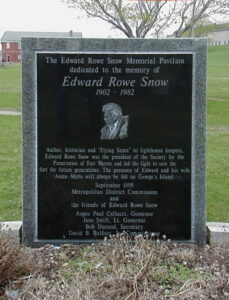
Once a sought-after guide to old Boston, regional lighthouses, and the harbor islands, Edward Rowe Snow passed away at the age of 79 on April 12, 1982. In August 2000, a plaque was dedicated to Snow on Georges Island in Boston Harbor. A Boston Harbor ferry boat was also named for him.
RELATED CONTENT:
Enchanting Christmas outings to put you in the holiday spirit
Visit the Newport mansions decorated for the Christmas season