By Sharon Oliver
Contributing Writer
BOSTON – As the country prepares to celebrate its semi-quincentennial (or quarter millennium) marking the 250th anniversary of the United States Declaration of Independence, we would be remiss to not recall a role or two that the great State of Massachusetts has played. One forgotten symbol of the American Revolution is the Liberty Tree, which was planted 16 years after Boston’s founding in 1646 and served as the rallying point for resistance against British rule.
Plaque marks location
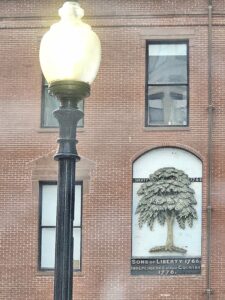
The once famous and stately elm is now represented by a bronze plaque lying ground level at Washington and Essex streets in Boston and located across the street is an 1850s bronze carving of the tree that adorns a building. Historian Alfred F. Young thought the site’s absence from Boston’s Freedom Trail was not by accident.
He argued in his 2006 book “Liberty Tree: Ordinary People and the American Revolution,” that “[Boston’s] Brahmin elite fostered a willful forgetting of the radical side of the Revolution.” Perhaps it’s one thing to let the Boston Tea Party symbolize revolutionary mischief, and another thing to celebrate mobs who threatened hangings, ransacked houses, and tarred and feathered folks.
On January 14, 1766, John Adams met with a radical secret society inside a small room in a Boston distillery. He wrote, “Spent the Evening with the Sons of Liberty, at their own Apartment in Hanover Square, near the Tree of Liberty.” The men discussed their opposition to Britain’s Stamp Act over cheese and biscuits and washed down with punch or wine. The hated Stamp Act required American colonists to pay a tax on nearly every document they created. Mortgages, deeds, contracts, court papers and shipping papers, newspapers and pamphlets – everything had to be printed on paper with tax stamps.
On August 14th, locals discovered the initials “A.O.” pinned to the effigy on the tree. The initials were that of Andrew Oliver, a Boston merchant who had agreed to collect the stamp tax. On it, a boot dangled with a small devil figure peeking up from inside the boot and holding a copy of the law. The sign read “What Greater Joy did ever New England see than a Stamp man hanging on a Tree!”
Calls to action
Protesters posted calls to action on its trunk and would often gather under the elm. For years, as tensions between the colonies and Britain grew, the rowdiest of demonstrations took place at the Liberty Tree. The 1768 Liberty riot was a protest over the seizure of John Hancock’s ship. It ended after the crowd seized a customs commissioner’s boat and dragged it from the dock to the Liberty Tree, held a mock trial on the premise and burned it on Boston Common.
In 1774, angry colonists tarred and feathered Captain John Malcom for firing a shoemaker. They took him to the Liberty Tree, where they placed a noose around his neck and threatened to hang him unless he cursed the governor. No one was cursed or hanged.
The British army chopped down the tree in 1775 and after they evacuated Boston in 1776, revolutionary Bostonians tried to reclaim the site. A “liberty pole” was erected on August 14, the 11th anniversary of the first protest but it didn’t last as a landmark — even though the Marquis de Lafayette included it in his 1825 tour of Boston. “The world should never forget the spot where once stood Liberty Tree, so famous in your annals,” Lafayette declared. Years later, Boston newspapers occasionally mentioned the site of the Liberty Stump.
A 23-foot-tall silver aluminum Liberty Tree that was created for the 1964 World’s Fair, was later moved to Boston Common, but it also failed to become a landmark.
RELATED CONTENT:
Plympton’s Deborah Sampson fought as a man in the Revolutionary War
Crispus Attucks of Framingham became an icon of the American Revolution
Worcester author chronicles one of Revolutionary War America’s most notorious crimes