By Michael Perna Jr.
Contributing Writer
REGION – In the late 1870s, it had become apparent that the city of Boston and surrounding communities were in dire need of an updated water supply. This was caused by a huge expansion in the city’s population – in the century from 1795 to 1895, the population had increased from 19,000 to 750,000 people – and an antiquated distribution system that used hollow wooden logs to distribute water. Other factors included the introduction of indoor plumbing in the late 1800s and the Great Boston Fire of 1872. This disaster resulted in one of the greatest losses of homes and businesses in the history of the United States.
Nashua River dam
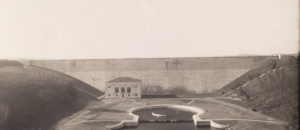
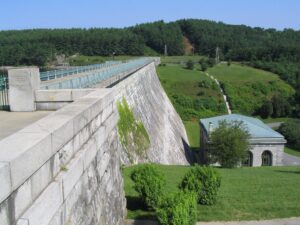
After some investigation, the Metropolitan Water Board settled on the idea of building a dam across the Nashua River in the town of Clinton. Construction on what would become known as the Wachusett Reservoir (known today by many locals as “the Res” or “the Chu”) began in 1897. When it was completed, it was the largest man-made water supply reservoir in the entire world.
A contract was awarded in 1900 to the McArthur Brothers from Chicago, Illinois. Construction of the reservoir did not come without sacrifices. More than 4,000 acres of land had to be cleared, resulting in entire neighborhoods being wiped out. Some 500 buildings were destroyed, and 4,000 graves removed and reinterred away from the site. West Boylston was the most severely impacted of any of the towns involved – which included Boylston, West Boylston, Clinton and Sterling.
Photo/Digital Commonwealth
It was reported that West Boylston had 300 homes, eight schools, six mills, four churches, and a hotel – to say nothing of the 1,700 residents displaced – moved to other locations.
Huge undertaking
The Wachusett Dam alone required the building of 27 linear miles of tunnels and the removal of 6.9 million cubic yards of soil. The work, much of which was done underground and under extremely harsh conditions, was not something most local residents were interested in doing. Many Black Americans and Irish and Italian immigrants were hired. They were required to live on the site in extremely poor conditions, which are reported to have resulted in thirty-five workers losing their lives due to fires, falls, poor air quality – even murder.
The local towns were less than thrilled with the worker population and discrimination was apparent. The town of Clinton barred alcohol sales for two years because of a fear of disorderly conduct. The worker’s pay was poor and intermittent. A number of strikes were without success until the Italian workers organized one that resulted in a stable wage of $1.50 a day, to be paid weekly, and eased the requirement for workers to live at the construction site.
The dam was completed in 1905, but the reservoir itself was not filled until 1908. This resulted in the creation of thirty-seven miles of shoreline.
Photo/Wikimedia Commons/Dale E. Martin
Legacy today
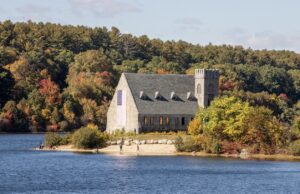
Today few vestiges remain of what once comprised a good part of the town of West Boylston. The most notable is certainly what has become known as the Old Stone Church. This iconic structure, despite deterioration over the years, has become an extremely popular tourist attraction, the subject of countless photographs for any number of occasions and the subject of many paintings as well.
The area surrounding the church site hosts many walking and biking trails and is a popular spot for local food trucks to serve meals to visitors. Being a protected water supply, swimming and boating are not allowed, however fishing from shore is permitted. Wachusett Reservoir is known widely in the region as a destination for trophy-sized lake trout and smallmouth bass.
RELATED CONTENT:
Remembering her childhood home – lost to the Quabbin Reservoir
Abandoned ‘ghost towns’ are scattered across Massachusetts
Keeping history alive – Richard Pickering of Plimoth Patuxet Museums