By Matt Robinson
Contributing Writer
REGION – For Monica Vegelj, straightening people out is both a figurative and literal mission.
In addition to being a schoolteacher, which she came to as a second career, she’s also a certified practitioner of the Alexander Technique. It’s an educational method that teaches individuals to change harmful postural habits and move with greater ease by increasing awareness of the body’s use. Its proponents say that it has helped thousands of people improve not only their posture, but their health. The goal is to overcome pain and other limitations through gentle physical and verbal guidance.
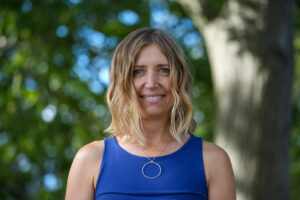
Vegelj, a 59-year-old New Hampshire resident, studied the Alexander Technique for several years under the supervision of Newton-based practitioner Ruth Kilroy, who traces her training back to Frederick Matthias Alexander, the inventor of the technique. Vegelj, who teaches the technique often for Massachusetts clients, originally learned about the Alexander Technique from another practitioner, Adam Bailey, who led an introductory group session for parents at her child’s school.
“We made observations about our habits in walking backwards and forwards,” she recalled. “I was impressed with the teacher’s ability to direct our attention in such a way that we all found something astonishing and new in these seemingly simple daily acts.”
Embracing the technique
Apparently, Vegelj was not only inspired to take a new view of her own ways of moving in the world, but also at what she wanted to do in it moving forward.
But first, she had to stand up.
“Volunteers were chosen for individual work,” Vegelj explained. “Adam invited us to make observations about their stance, as well as their habits as they sat down and stood up. I could see that the person was not perfectly upright, but with a very light fingertip touch and some verbal directions, the volunteer achieved a much more upright stance.”
When Bailey asked for another volunteer, Vegelj eagerly raised her hand.
“I will never forget our verbal exchange when Adam guided me out of the chair,” she said. “It felt like learning how to breathe.”
Amazed at the transformation she had observed, Vegelj decided to dedicate her teaching path to helping others realign their lives by straightening out how they use their bodies.
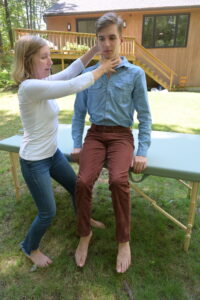
“I couldn’t help reflecting on the enormity of the lived experience,” she noted. “One moment I was sitting down, then without much effort whatsoever, almost no effort, I was standing.”
Education as a calling
Educators are considered a rare breed by some people. They dedicate their lives to supporting other people and deal with long hours and low pay, and hope that they can make a difference and help other people improve their own lives.
While some see teaching as a job, many of those engaged in it say they know it is a calling.
For Vegelj, that calling came early. “It started when I was a four-year-old child,” Vegelj recalled. “I trained three little kittens in our home to walk!” And while this early introduction to early education may seem a bit too cuddly to count, Vegelj maintained that her passion for teaching and supporting others (regardless of age or species) was authentic.
If cat training does not do it for you, Vegelj has another example of her educational endeavors from just a few years later.
“My first-grade teacher asked me to assist my classmates with math,” she recounted. And though she admits to thinking it odd that the teacher was asking her to teach something she had just learned herself, Vegelj was game and again made her best efforts to help others in apparent need.
That experience launched me into peer tutoring,” Vegelj reasoned, “which continued throughout high school and college.”
Even in her extracurricular pursuits, instructors saw in Vegelj a natural proclivity to teaching. “As a child, I practiced gymnastics,” she said, “and I was approached by the owner of the gymnastics club to coach the preschool and kindergarten-aged children. I had this part-time teaching job throughout high school.”
Even when her true professional path took a turn away from teaching, she was unable to completely abandon the gift that so many others had seen in her since her earliest days.

“In my first profession as a registered dietitian, I was hired by the hospital where I did my internship to work in outpatient nutrition education and counselling,” Vegelj explained. “So even as a health care professional, I worked as a teacher.”
All of these experiences led Vegelj to a conclusion that had apparently been shared by many others.
“It’s not so much that I chose education,” she admitted, “but rather that education chose me!”
Launching her second career
Though her educational examples continued to build, Vegelj did not formally reenter a school until it was time for her own children to do so. As she dutifully toured various options in her area, she sought a place where her children could get the type of academic and life support that she had hoped to provide to cats and gymnasts and others throughout her life.
Once her children were enrolled and engaged in a Waldorf-inspired private school, Vegelj found her old yen for teaching coming back. She soon found herself getting more involved at the school — first as a parent, then as a volunteer, then as a member of the parent association and a member of the board of trustees, and eventually as a Waldorf-trained teacher.
As is true of all teachers, Vegelj continued to learn as she taught. The lesson in particular that would have a profound impact on her own professional and personal paths was the introductory workshop at the school about the Alexander Technique. And becoming a certified practitioner was a long and complex path.
“This process takes three years,” she explained, “during which one is confronted daily with pernicious and persistent ways of one’s own habits. If you approach with anxiety, fear of any kind, judgement, or frustration, all of these responses interfere with the work, If you, on the other hand, enjoy the process, then the rewards are incredible.”
Special benefits for older people
While the Alexander Technique can work for people at any age, Vegelj sees special benefits for older people like herself.
“The Alexander Technique can be particularly valuable for the elderly by helping them address common challenges associated with aging and improve their overall well-being,” she maintained. She cited noted improvements in posture and balance, which are key to fending off injury and degenerative diseases.
For example, she said Alexander students are often able to maintain the gait of their younger days instead of becoming shufflers. It can also help people of any age learn how to inhibit what Vegelj cites as “unhelpful patterns” of behavior and movement and “direct themselves more efficiently,” making pain a less common visitor as well. Also, as the technique is an education and not a form of treatment, people who learn it can be constantly observing and supporting themselves, even between lessons.
“So long as you have the ability to think,” Vegelj maintained, “you are able to practice the Alexander Technique.” And as it is based in thought and energy, she explained, she said it is far more efficient and effective than many other forms of treatment.
“If we are all exerting so much undue effort in the simple act of standing, sitting and getting up,” Vegelj observed, “imagine how much more we are capable of if we could learn to direct our energy more efficiently?”
RELATED CONTENT:
Milford engineer turns to the yoga mat for encore career
Sitting all day can be harmful to your health
Walking benefits emotional wellbeing as well as physical health