By Sharon Oliver
Contributing Writer
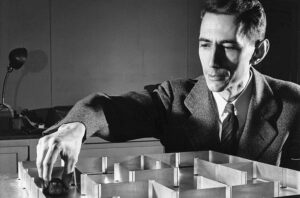
CAMBRIDGE – Anyone who frequents casinos would love to beat the house at least more than once or twice each and every time they visit. So, what are the odds of that actually happening? Well, in 1961, Edward O. Thorp and co-developer Claude Shannon of the Massachusetts Institute of Technology (MIT) in Cambridge invented a computer designed to predict the outcome of roulette wheels. The wearable computer was about the size of a pack of cigarettes or playing cards that could be worn strapped to the waist, with foot switches hidden in a shoe.
Mathematicians at the casino
Thorp, a mathematics professor and blackjack researcher, learned Fortran (a programming language designed for numeric computation and scientific computing) in order to program the equations needed for his theoretical research model on the probabilities of winning at blackjack. Blackjack is the most widely played casino banking game in the world and the house’s edge is usually around 0.5–1% when players use basic strategy. However, card counting can give a player an edge of up to about 2%.
Thorp teamed up with Claude Shannon, another mathematician and computer scientist, to build a device that would time the spinning of the ball on a roulette in order to predict where it would land. Thorp first devised card counting schemes with the aid of the IBM 704, a high-speed electronic calculator. He then tested his theory in Reno, Lake Tahoe and Las Vegas with $10,000 on hand for use at blackjack tables.

The money was provided by Manny Kimmel, a wealthy professional gambler, as venture capital and the gamble proved successful. Since this was not a one and done experiment, Thorp made more trips to casinos and often used disguises such as wraparound glasses and false beards. He also assembled a baccarat team who also brought home winnings.
Shannon, also known as the “father of information theory” and a distant cousin to Thomas Edison, took his wife Betty on weekend excursions to Las Vegas to play blackjack and roulette. The Shannons lived in a large home in Winchester with a basement described as a “gadgeteer’s paradise” equipped with thousands of dollars’ worth in electronic, electrical and mechanical items. Shannon’s team was the first to use the newly invented wearable computer to play roulette. The device relied on a pair of operators, where one would watch the wheel and use his toe to input the cadence of the wheel, and the other would receive a message in the form of musical tones through a hidden earpiece. By betting on groups of neighboring numbers on the wheel, they could gain an ample advantage to winnings.
Photo/Courtesy of the MIT Museum
Gambling celebrity
News about this device soon spread within the gambling community, making Thorp a celebrity among blackjack players. As a result of proving players could beat the house in blackjack by counting cards, Thorp wrote the book “Beat the Dealer” in 1962 which earned a place in the New York Times bestseller list.
In almost all jurisdictions, casinos are permitted to ban customers who they believe are using advantage play from their premises. These days, most casinos have an extensive array of security cameras and recorders which monitor and record all the action in a casino that can be used to resolve some disputes. The use of external devices to assist in card counting is illegal in Nevada but Thorp’s approach inspired others to look for physical rather than mathematical advantages in casino games.
The device now resides at MIT as an exhibit. Thorp is now 93, with an estimated net worth of between $800 million and $1 billion. With the wealth earned from casinos winnings Thorp turned to financial markets to invest his money and became a hedge fund manager.
RELATED CONTENT:
Boston’s North End: A Red-Light District’s Transformation
Former Casino Manager Now Counsels Gamblers: Resources for Problem Gambling
Las Vegas Beyond the Casinos: Entertainment, Nature & History