By Michael Perna Jr.
Contributing Writer
SHREWSBURY – During the year 2026, when the United States celebrates its 250th year of independence, it is only fitting that we remember the Shrewsbury resident that played a significant role in the American Revolution – Major General Artemas Ward.
Artemas Ward was born in 1727 in Shrewsbury (the same year Shrewsbury became a town). He grew up in Shrewsbury and attended local schools before attending Harvard, graduating in 1748.
Early political and military career
He was married to Sarah Trowbridge of Groton, in 1750. The couple returned to Shrewsbury and opened a general store, eventually having eight children. Artemas became involved in political office at an early age, becoming a township assessor for Worcester County in 1751, followed by a number of different positions, and eventually being part of the Court of Common Pleas, where he served with John Hancock and Samuel Adams.
He also served in the Massachusetts Militia, eventually being named as a general and the first commander-in-chief of the Massachusetts Militia in October 1774.
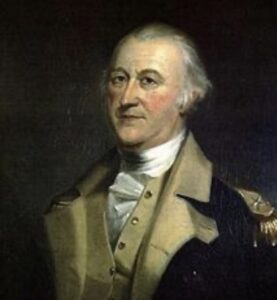
When the American Revolution began, he was ill but directed his troops from his sickbed in Shrewsbury. After the Battles of Lexington and Concord, both New Hampshire and Connecticut named him as the commander of their forces.
Battle of Bunker Hill
When more British forces arrived in Boston during May, Ward discovered that they planned to attack Bunker Hill and subsequently ordered his forces to occupy that location. He placed General Israel Putnam and Colonel William Prescott in charge of the troops there. It was on the same day, June 17, 1775, as the battle raged that the Continental Congress commissioned Ward as a major general, second in command only to George Washington.
It was Colonel Prescott that decided to secretly move the troops occupying Bunker Hill to Breed’s Hill, which was nearby but closer to the Charles River, this taking place on the night of June 16. The next day, approximately 2,300 British regulars made a frontal assault on the Colonial earthworks.
The Colonial forces, numbering about 1,000, were extremely low on ammunition. It was at this time they were given the famous order “Don’t fire until you see the whites of their eyes!” This they did, waiting until the British lines were almost upon them before firing a devastating volley. The British made a second charge with similar results, then attacked a third time. At this point, the Colonial forces, their ammunition having run out, were ordered to retreat, but not before they had inflicted over 1,000 casualties on the British while suffering roughly 450 losses of their own.
Although the British were ultimately successful, it proved to be a great boost to the morale of the Colonial forces, proving they could stand up to the regular forces of the British Army.
The British Army lost a number of its leaders in the battle, including General Joseph Warren. The Battle of Bunker Hill forced the British to change their previous tactic of head-on attacks, and they subsequently evacuated the city of Boston on March 17, 1776.
Departure from the army
After that, General Washington took most of the Colonial troops to New York, however, Ward continued to serve as the commander of the “Eastern Department” until he resigned from the Army due to his poor health.
Artemas Ward never got over the fact that Washington had replaced him. During a trip Washington made through Shrewsbury years later, he stopped by Ward’s house to say hello – Ward reportedly refused to come out to greet him, saying he was too ill!
Years later, the Bunker Hill Monument was erected to preserve the history of the battle, even though (as we know) the actual battle took place at Breed’s Hill.
RELATED CONTENT:
Plympton’s Deborah Sampson fought as a man in the Revolutionary War
Worcester author chronicles one of Revolutionary War America’s most notorious crimes
The Liberty Tree: a rallying point in America’s fight for independence