By Colin McCandless
Contributing Writer
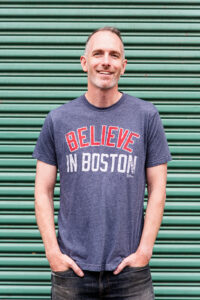
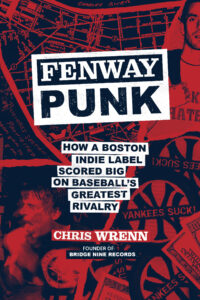
BOSTON – Boston hardcore punk fan Chris Wrenn has made a career out of hating on the Yankees. Last February, the Beverly resident, who grew his record label by selling “Yankees suck” merchandise outside Fenway Park, released his book “Fenway Punk: How a Boston Indie Label Scored Big on Baseball’s Greatest Rivalry,” where he tells his improbable tale.
Wrenn, now 50, launched his independent hardcore punk record label Bridge Nine Records in 1995 during his sophomore year at Green Mountain College in Poultney, Vermont. He said he attended school there to stay connected to Boston’s fertile punk scene.
Bootstrap start
As one might surmise, Wrenn started the project with scant resources. “Everything was bootstraps,” recalled Wrenn. He followed in the DIY spirit of the punk/hardcore ethic and its grassroots approach, where people from an early age often release their own records, tour as teenagers, print their own T-shirts and book their own shows,
He had plenty of examples to emulate in the punk music scene. “You kind of see people creating these opportunities. And when you see it happening, it makes it more real, and more attainable. It’s no longer just a concept, it’s something that you can see executed,” noted Wrenn.
He initially funded Bridge Nine by selling novelty slogan bumper stickers to the national retail chain Hot Topic in the mid-1990s, which afforded him enough money to release one or two records a year. Wrenn sold tens of thousands of stickers nationwide before this entrepreneurial opportunity dried up in the late ‘90s.
Red Sox rivalry with Yankees
Now Wrenn turned his attention toward the next economic venture that could keep his musical enterprise going. In real estate lingo, they say location is everything, and in 1999, Wrenn, along with many of his friends, lived in the Mission Hill neighborhood less than a mile from Fenway Park. Around this time, “Yankees suck” was the number one chant heard at games, whether the Red Sox were playing their hated rivals or not. You also overheard it at wedding receptions, concerts – well, you get the picture – Bostonians generally despise the team in pinstripes. “Red Sox fans, it resonated with them, so making merchandise that said, “Yankees suck” was a very easy opportunity to kind of jump on,” reflected Wrenn.
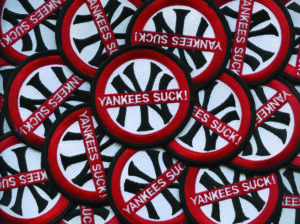
The decision to sell merchandise (T-shirts, bumper stickers, patches, pins) bearing the slogan was a no-brainer. But he is quick to point out that his group of entrepreneurs weren’t the first people to push these items. Wrenn discovered while researching his book that vendors peddled ‘Yankees suck’ or ’Yankee hater’ (which Wrenn also sells) emblazoned merch as far back as the ‘70s. “So there’s a proud tradition of wearing your emotion on your T-shirts,” he said.
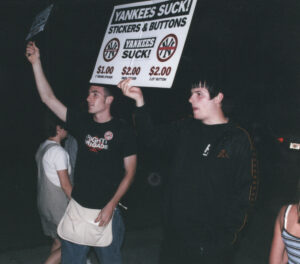
Wrenn’s crew included local bands from the punk hardcore scene such as American Nightmare, roommates of his at the time who had agreed to release their first record through Bridge Nine. As a band aspiring to tour regularly around the country, they sought opportunities to earn money on a gig basis, which Wrenn could offer at Fenway. He was joined by friends, other members of multiple bands he worked with and even unpaid interns at his record label. “It was a win-win,” he recalled.
Facing challenges
The first issue to address was the other competitors selling merch outside the stadium. “We had to establish ourselves,” recounted Wrenn. There would be anywhere from a dozen to 20 of them working together at any time, which they used to their advantage. “We were able to protect our interests with just our sheer numbers,” asserted Wrenn.
Another problem involved the code enforcement police, who patrolled the grounds requesting permits for mobile vendors. The permit imposes tight restrictions on vending times and was only valid from 8 p.m. to 8 a.m. Wrenn explained that they black out the times during the day because they don’t want hawkers competing with brick-and-mortar retail stores. That put their crew in a position where they could only sell to the outgoing crowd.
Early on they attempted to sell to people coming into games, but code enforcement put the kibosh on that. For several years his squad would play cat and mouse games with code enforcement, paying people to monitor the cops’ location and communicate their coordinates via walkie talkies. That is until Wrenn became friends with the head of code enforcement officials (Wrenn refers to him as Tiger in the book). They developed a strong bond and even later attended each other’s weddings.
Success comes quickly
Hating on the Yankees is a favorite pastime of Sox supporters, but did Wrenn ever imagine he would make enough money to support and grow his label? He didn’t have to wait long for the answer.
By 2000, within just one year of selling “Yankees suck” merchandise, Bridge Nine had already gone from promoting two bands to three. That number skyrocketed to 12 by 2001 and 14 in 2002. Subsequent years saw Bridge Nine promoting up to 25 releases. “The money I was making at Fenway Park basically allowed me to ramp up very, very quickly,” related Wrenn.
When he started, Wrenn worked a day job in the art department at Tower Records where he made only $1 an hour above minimum wage. He earned more money on his first day hawking bumper stickers at Fenway than in two weeks at Tower. “So it was eye opening,” he said.
Wrenn continued his Fenway operations through 2017. By this time, his company had a presence, and he farmed out the business to a magazine vendor who sold products to people coming into the game. Also in 2017, Wrenn began a partnership with retail giant Target, which dedicated around 400 to 500 square feet of space inside the Fenway Park Target store to his “Yankees suck” brand.
A blend of subcultures
His endeavor highlights a unique melding of subcultures between the Boston punk and sports scenes. Is this the exception or the norm? “So Boston is, I believe, the exception,” stated Wrenn. “Growing up in central Connecticut, there was a very large gap between the punks and the jocks. There was not a lot of overlap. And that’s true in most cities. For whatever reason, Boston has embraced the sports fan identity through music.” He cited high-profile examples like Boston punk legends Dropkick Murphys, who have performed at Fenway Park. Additionally, the Red Sox pitched the song “Tessie” to Dropkick Murphys, a tune they completely reworked in summer 2004 that became a Sox anthem.
Bridge Nine Records has now released more than 300 recordings, building the reputations and exposure of hardcore bands such as Terror, Defeater, Have Heart and Death Before Dishonor, while also working with established groups including H20 and New Found Glory and even releasing a single from Dropkick Murphys. Selling “Yankees suck” merchandise, which has financed the plucky independent record label Wrenn launched in his college dorm room and helped promote and cultivate the hardcore bands he loves, made it all possible.
Bridge Nine has a punk records store in Beverly that provides a visual illustrating the symmetry between the two seemingly incongruous worlds of punk music and sports, where both punk T-shirts and Boston sports rivalry apparel are sold side by side. “To anyone that’s from out of state, it’s strange that there’s punk music and sports apparel,” acknowledged Wrenn. “Once I realized there was so much crossover, I said ‘we should do a very front-facing retail space that has both brands.’ And it’s been successful, so we’re happy.”
RELATED CONTENT:
Revere teacher turns her punk rock youth into life lessons for students
Writing a Memoir About Quincy & Searching for His Missing Father
‘Chronicle’ producer has balanced second career as alternative rock musician