By Michael Perna Jr.
Contributing Writer
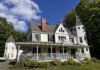
WORCESTER – George Bancroft was born in Worcester on October 3, 1800. His family had been in Massachusetts since the year 1632. His father, Aaron Bancroft, was a veteran of the Revolutionary War, a well-known clergyman and author, writing a biography of George Washington.

Educational prodigy
George attended Phillips Exeter Academy as a boy, then entered Harvard College at the age of thirteen, graduating at the age of seventeen in 1817.
He then continued his education at the Universities of Gottingen and Berlin in Germany. He earned his doctorate degree from the University of Gottingen at the age of 20. He completed his education by touring Europe, where he sought out several noted educators.
Upon returning to the United States in 1822, Bancroft served as a tutor at Harvard before becoming disillusioned with that institution. He began writing, which would become a lifelong passion.
Political career
He went on to found the Round Hill School in Northampton, before entering politics in 1837, when he was appointed as Collector of Customs in Boston, MA. After a failed bid to be governor of Massachusetts, he was appointed as the Secretary of the Navy in 1845, then had a short stint as the Secretary of War. While in that position, he founded the United States Naval Academy at Annapolis and played a key role in forcing Mexican forces out of what is now the state of Texas and the occupation of California.
In 1846, Bancroft was named Minister Plenipotentiary to England. He went on to serve as a senior diplomat to both Germany and Great Britain. His appointment ended with the election of Zachary Taylor as president. Upon his return to the United States in 1849 he left government service and moved to New York.
After initially being critical of President Abraham Lincoln (he described him as “without brains” and “ignorant, self-willed, and…surrounded by men some of whom are almost as ignorant as himself,”) he later became a supporter, urging him to abolish slavery and encouraging him in the writing of the Gettysburg Address. In fact, he was selected to deliver Lincoln’s eulogy in 1866.
In 1867, he returned to public service, being appointed as the U.S. minister to Prussia – he remained in Germany for seven years, spanning the Franco-Prussian War and the unification of Germany.
He was then appointed minister to the German Empire by President Ulysses S. Grant in 1871. His efforts in negotiating agreements between a number of German states became known as the Bancroft Treaties.
Bancroft returned to the United States, where he lived in Washington, D.C. He spent his summers in Newport, Rhode Island at a spot called Rose Cliff – which later became the site of Rosecliff mansion.
He was married twice, first to Sarah Dwight, who came from a wealthy Springfield family. They were married in 1827 and had two sons before she passed away in 1837. He later married Mrs. Elizabeth Davis Bliss, who was a widow with two children. They later had a daughter together.
Later work and legacy
Bancroft had a deeply rooted interest in history. He was an accomplished author – perhaps his most well-known work was entitled “History of the United States, from the Discovery of the American Continent,” which detailed the country’s history up to the year 1789. He also authored a comprehensive history of colonial America, starting in 1834 – he revised this work several times over the course of time.
In recognition of Bancroft’s many achievements, the city of Worcester paid tribute to him in a number of ways – the Bancroft School was named after him; the 56-foot high Bancroft tower, erected in 1900, still stands in Salisbury Park, where it was erected in Bancroft’s honor by Stephen Salisbury III; the former Bancroft Hotel in downtown Worcester was a popular destination for many years, with visitors that included Presidents Franklin Roosevelt and Dwight Eisenhower and entertainers including Elvis Presley and Frank Sinatra.
George Bancroft – a distinguished Worcester native, passed away in January 1891 although his legacy still lives on.
RELATED CONTENT:
Worcester’s Lincoln Park is a nearly forgotten part of the city’s history
Worcester was the birthplace and is still the home of Table Talk pies
Mechanics Hall is Worcester’s most historic musical venue