By Sharon Oliver
Contributing Writer
REGION – When it comes to New England’s weather, winters are notorious for being brutal. Recent years have certainly seen some hot summers, however. The summer of 1911 hit the area with one of its most unforgivable heat waves. In July 1911, Boston and other northeastern cities were overtaken by a heat wave that had tar-surfaced streets bubbling in the hot sun, horses dropping in the middle of the street, grass turning to dust, mail service was suspended and some babies did not wake up from their naps.
That was only the half of it. During a time when widespread use of air conditioning or electric fans was practically nonexistent, people suffered from unbearable heat for 11 days and poor ventilation along with cramped living spaces only exacerbated the problem.
Heavy human toll
The 1911 heat wave even bent rail lines, causing derailments. On July 11th, a train carrying passengers from Washington to Boston derailed as it approached the Bridgeport, Connecticut station. The engine and six cars went down a 20-foot embankment, killing 14 and injuring 47. The St. Louis Cardinals, who were on their way to Boston to play the Braves, were sleeping in a Pullman car of the train that miraculously remained on the tracks. Baseball Hall of Famer Roger “the Duke of Tralee” Bresnahan was credited with saving many lives before ambulances arrived thanks to his directing the team’s rescue efforts.
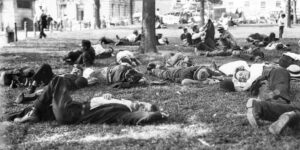
On July 4, 1911, temperatures hit 104 in Boston. Approximately 200 people drowned while trying to cool off in lakes, ponds, rivers and the ocean. People slept on roofs, parks and beaches. Tenement slums and sidewalks were covered with blankets and mattresses for sleeping outside, but this came with the risk of being robbed, something that did occur often. More than 5,000 men, women and children slept on the grounds of Boston Common, which then became known as the “biggest boardinghouse in New England.”
Reading the morning newspapers to learn of deaths would soon become a ritual. Workers died digging holes. Women fell over picking blueberries. A teamster fainted and fell off his wagon, only to be trampled to death by the horses pulling it. A woman sitting up in bed talking suddenly keeled over, dead. In Hartford, Connecticut, a 28-year-old Italian immigrant named John Merlo rolled over in his sleep on the roof of his boardinghouse, crashed through a 10-inch guard and fell to his death on the concrete below.
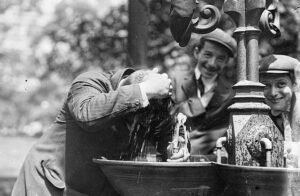
People started to go mad. In Springfield, a man threw off his coat and ran through a pharmacy. Jacob Seegar, of Roxbury, was so crazed by the insufferable heat he killed himself with a revolver to escape it. There were other suicides reported as well. At the L Street Bath and Beach located in South Boston, Irish bathers were enraged at the sight of Jews, Italians, and other “foreigners” cooling off at the beach and using the bathhouse.
Wave of relief
Suddenly, after days of intolerable temperatures, a thunderstorm brought a wave of relief. A second thunderstorm brought temperatures back down to more comfortable levels. However, five more people died from lightning strikes.
Prior to the 1911 event, Revere Beach had opened as the first public beach in the nation in 1896. A few weeks later, tens of thousands fled to the beach to escape the summer heat. That same year, the first streetcar arrived in Ipswich and offered shaded transportation to residents.
On August 11, 1896, The Boston Globe reported 10 fatalities occurred in Boston from the heat, 20 the following day, and 15 more on the 13th when the heat wave finally subsided.
New England’s death toll from the 1911 heat wave topped 2,000, with 1,100 in Massachusetts alone. Salem had the highest rate of death with 37 heat-related deaths recorded.
RELATED CONTENT:
No one reported inclement weather like WBZ-TV’s Shelby Scott
Forecasting New England weather is a lifelong passion for Harvey Leonard