By Michael Perna Jr.
Contributing Writer
REGION – Throughout Massachusetts, vestiges of the Cold War can sometimes be seen, curious reminders of a time when the world’s nuclear superpowers kept a wary eye on each other through various means.
Early warning radar system
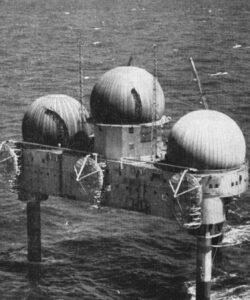
The Texas Towers were part of the United States’ efforts to have an early warning radar system in place to provide warning of any Soviet attack. The original plan was to have five Texas Tower installations along the East Coast, however only three were actually built. The name Texas Tower came from the resemblance of the structures to the many oil drilling platforms located off the coast of Texas, in the Gulf of Mexico.
Work was begun on Texas Tower 2 in 1955 at the Fore River Shipyard in Quincy. By June of that year, enough of the tower had been completed to allow it to be towed to its permanent location, on Georges Bank in fifty-six feet of water, 110 miles east of Cape Cod. After it had been put in place, three early warning radars, one AN/FPS-3 search radar and two AN/FPS-6 height finder radars were installed, this being completed in December 1955. The radar systems were developed by the U. S. Air Force’s Rome Air Development Center in Rome, New York.
The tower had a crew of six officers and forty-eight enlisted personnel. The crew was assigned to the 762nd Aircraft Control and Warning Squadron, which was based at the North Truro Air Force Station in North Truro on Cape Cod. It was estimated that, due to its location, the tower would be able to detect an attack between 300 and 500 miles further offshore than radar systems on the shore, which would give an additional thirty minutes’ warning.
Challenging living conditions
Texas Towers 2 and 3 became fully operational in 1958, followed by Tower 4 in April 1959. Two other towers, 1 and 5, never came to be built. The Texas Towers were known to have poor living conditions for their crews – they were noisy due to vibrations from the radar equipment; this, combined with shaking and swaying due to the ocean’s waves and wind and the frequent use of fog horns on the towers made life pretty miserable most of the time.
The most unstable of the towers was Texas Tower 4 off the coast of Long Island in New York, due to it being positioned in much deeper water than the others. Despite a number of attempts to install braces on the tower’s legs in order to stabilize it, it shook constantly, leading it to be nicknamed “Old Shaky.” The tower’s crew experienced frequent sea sickness due to the shaking.
Disaster strikes
In September 1960, Hurricane Donna struck the tower, causing a good deal of damage. After conducting a damage assessment, it was determined that the tower should be shut down, however a skeleton crew remained on board due to fears that the Soviets would be able to board the structure and access classified equipment if it was completely abandoned.
This resulted in a horrific disaster in January 1961, when a second storm hit the tower, causing it to completely collapse and sink. Efforts to evacuate the tower’s crew by ships before the storm struck were unsuccessful – there were no survivors – twenty-eight airmen and civilian contract workers died and only two bodies were recovered from the site of the wreck.
Closing of towers
This event, combined with advances in the Soviet Union’s ICBM capabilities that reduced the threat of airborne attacks, prompted the closure of the two remaining Texas Towers in 1963. Tower 2 off the coast of the Cape was supposed to be returned to shore to be turned into scrap but collapsed into the ocean as it was being prepared to be moved. Tower 3 was filled with foam, then dismantled and floated to shore and turned into scrap.
The mission that the Texas Towers had performed was then taken over by EC-121 Early Warning Aircraft based at what was then Otis Air Force Base (now Joint Base Cape Cod) in Falmouth.
Today, the remains of Texas Tower 2 sit on the ocean floor, mostly forgotten except for a handful of scuba divers that still occasionally visit the site of this once important part of our national defense.
RELATED CONTENT:
Grounding of the cargo ship Etrusco in Scituate became a tourist attraction
Storyteller Don Wilding on Cape Cod History: Shipwrecks, Storms & More
Provincetown’s “Butch” DeAvellar was a beloved character for decades