By Michael Perna Jr.
Contributing Writer
SCITUATE – For residents of the South Shore town of Scituate, St. Patrick’s Day in 1956 delivered what is perhaps their biggest holiday surprise ever.
Major storm
During what was supposed to be a routine voyage from Germany to Boston in March 1956, disaster struck the SS Etrusco, a 411-foot-long Italian cargo ship that weighed 7,000 tons. The ship ran into a storm just before St. Patrick’s Day – the seas turned rough with huge waves, strong winds and falling snow quickly turning into blizzard-like conditions. The Port of Boston was closed to shipping because of the storm, so the ship had to turn around and planned to ride out the storm in the open ocean.
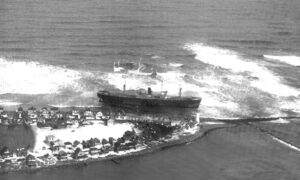
The crew of the ship lost their bearings. Soon, a blinking red light could be seen off in the distance. The crew called the Coast Guard, and it was determined that the light they were seeing was located on the jetty at the entrance to Scituate Harbor. By the time the ship received this information, the huge swells and high winds, estimated at 60 knots, pushed the ship aground, onto the rocky shore close by the historic Scituate Lighthouse, on what is known as Cedar Point.
Fear-filled night
The crew had to spend a fear-filled night, not knowing what would come next. After ten hours, on St. Patrick’s Day, the Coast Guard was able to assist them, with crews from lifeboat stations at Scituate and Point Allerton. A cable was run from the ship to the shore, and the crew was evacuated one at a time, using what was known as breeches buoy.
Luckily for the crew, one of the closest houses to the ship was home to Ms. Eva Russo. Ms. Russo was an Italian émigré, who still spoke Italian fluently, allowing her not only to communicate with the crewmen, but to interpret for them with the Coast Guard personnel.
Ms. Russo then took the crew in, allowing them to stay with her and preparing home cooked Italian meals for them until the situation could be resolved. Other townspeople helped the crew out by dropping by with meals and clothing items.
Surprisingly, this columnist (at the age of 75 now) remembers seeing the grounded ship as a six-year-old. Friends of my parents owned a cottage located on Rebecca Road, overlooking the open sea and within a few hundred feet of the Etrusco. During visits in the time following the wreck, I was totally in awe looking out the window of the cottage or playing on the deck between the house and the seawall, seeing the huge freighter on the rocks.
Tourist attraction
The ship itself became a popular tourist attraction, with people travelling from all over to the little town of Scituate to view the freighter. One period photograph shows the parking lot near the lighthouse jam-packed with cars, with long lines of people standing waiting to get a view of the wreck. Another photo shows an old school bus that had been converted to a mobile hot dog and coffee stand parked near the ship, with large crowds waiting their turn to grab a “dog.”
After eight long months, the ship was finally repaired. The company that owned the vessel had decided to sell it off for scrap. As a token of appreciation for the people of Scituate, it was decided to rename the ship the “SS Scituate.”
When the ship was refloated and brought out to sea, it was big news – The New York Times noted the event with the headline:
“GROUNDED VESSEL MOVES OUT TO SEA
Ex-Italian Freighter Etrusco, Driven Ashore at Scituate, Mass., Is Refloated”
Later, a marker was placed near the site of the Etrusco’s grounding – this can still be seen by visitors today.
RELATED CONTENT:
Storyteller Don Wilding on Cape Cod History: Shipwrecks, Storms & More
Edward Rowe Snow: The Flying Santa of New England Lighthouses