By Matt Robinson
Contributing Writer
ARLINGTON – Usually, when interviewing a musician or artist, the first question is something along the lines of “When and how did you get into your art?”
Try to sneak this question by Grammy-nominated harpist, composer, and inspirational keynote speaker Deborah Henson-Conant, however, and she will quickly turn the tables on you.
“It’s more like ‘How did music first get into you?’” she suggested, and then responded to her own reframed query by explaining, “I was never not into music!”
Music in the home
Though she only remembers a few record albums in her childhood home (among which were the soundtrack to “South Pacific,” Ken Nordine’s clever “Word Jazz,” an album intended to help listeners learn Russian and an opera album that had the vocal track removed so people could sing along), Henson-Conant insists that there was always music in the home.
“Music was the way that my relatives communicated with me,” the Arlington resident observed, noting that each family member had a signature song. “I don’t remember a time when people weren’t singing to me.”
She also recalls that nearly everyone in her family had a piano and that she was encouraged to experiment with it to her musical heart’s content.
“I was allowed to play with musical instruments basically as if they were toys,” she said. “Nobody stopped me from exploring the piano, short of taking it apart, which was frowned upon.”

As music was such a part of her household, it was also odd for Henson-Conant to go outside the home to hear it.
“You didn’t have to join an a capella group or a choir to do this,” she noted, “everyone just did it. You didn’t go somewhere to hear music – you just played it.”
In fact, she and her brother often brought people to her home to experience the level of musical mastery that she enjoyed on a daily basis.
“My brother used to say to his friends, ‘I’ll bet I can make you cry without touching you.’ And they’d be like, ‘Oh, yeah?’ And he’d say, ‘Yeah, come home with me.’ They’d come home and he’d say to our mother, ‘Mom, sing to them. Sing them an aria.’ She’d put on her ‘Music Minus One’ record and sing. Even little kids would just start crying because it was just so emotional!”
Deep and lasting impact
That emotion and the musical power her mother held has had a deep and lasting impact on Henson-Conant, as had the way her mother and aunt (another talented vocalist) were treated by others in their field.
“I saw both my mother and my aunt – powerful, beautiful women – lose auditions because they didn’t ‘look right with the leading man,” Henson frowned. “That impacted me deeply and I swore that I will never be dependent on someone else to tell me whether I can perform or not and that the shows I write will always be performable by the greatest performer, regardless of how they look.”
Though Henson-Conant impresses legions of fans with her performing talent and also with unique sense of style, this dedication to independence and a focus on substance over (visual) style is consistent and important and has brought her to the attention and into collaboration with people who otherwise might not have been heard.
Among her most impressive partnerships has been a performance of her original composition “Baroque Flamenco” (which had been premiered by the Boston Pops) by Ukrainian artist Iryna Lytvynenko, a virtuoso of the Ukrainian national instrument known as the bandura, who asked Henson-Conant for permission to adapt the piece herself for bandura and Ukrainian folk orchestra.
“In the midst of a war zone in near blackout conditions [with] no heat in the rehearsal room [and] only a generator to light the stage,” Henson-Conant said of Lytvynenko’s premier, “she got so many flowers she could not take them off the stage!”
Early aspirations as a composer
Speaking of her compositions, Henson-Conant explains that she wanted to be a composer from the time she was young.
“When other kids were doing sports or sending off box tops,” she grinned, “I was sending songs into the copyright office.”
In fact, she actually credits her compositional proclivities with her hyphenated name.
“My parents split when I was around a year old,” she recalled. “Eventually, my mother remarried a man named Larry Conan but my father, Burt Henson, lived on the West Coast. So I was called Deborah Conant on the East Coast and Deborah Henson on the West Coast.”
Taking a tip from fellow composer Nikolai Rimsky-Korsakov, she combined the two identities into one and continued forging her own path.
“Now I get to live by performing, teaching and composing,” she maintained. “I play music I love…with stories that are funny, or tender or deep. I walk on stage as myself and let that transformation happen when a human becomes the music they’re playing.”
Teaching others
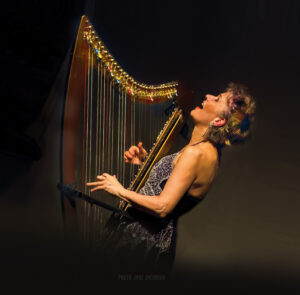
Henson-Conant also teaches other harpists how to improvise and create their own music through her Hip Harp Academy, just as she does with her own instrument that is always near to her heart.
While the harp has become her weapon of choice in the fight for musical inspiration and individuality, Henson-Conant first explored musical theater.
“Stories with music were what made my world spin,” she recalled, noting that she composed her first musical at the age of 12. “I always identified as a creator of musical theater. The thread that brought it together for me was the storytelling and the opportunity to embody character in the music.”
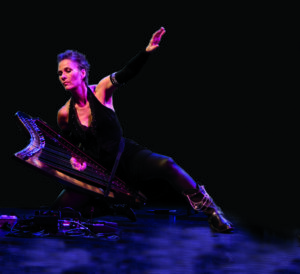
Ever the independent, Henson-Conant found an instrument that was not among the more popular and made it her own. Instead of standing tall on the side of the stage, her harp (like her music) is personal, nimble, and ready for almost anything.
“The wearable electric harp was the perfect companion for musical storytelling,” she proclaimed. “It could be not just an orchestra, but a prop, a costume, a set and even a character. I thought I’d chosen it as a practical way to make a living while writing music – only to discover it was a powerful way to tell those stories and bring them alive on stage!”
Creating a legacy
The rest, as they say, has been musical history; one that Henson-Conant is now striving to catalog and contain in an ambitious project for which she seeks outside support.
“After decades of performing my own original pieces on stages worldwide,” she says on the website for the DHC Legacy Project (www.hipharp.com/legacy-project), “I know what it means to have music that unlocks and empowers an artist’s self-expression.”
As only a small percentage of her catalog has been published, she is asking fans and friends for donations to help her finish this project so that her music can be available for the international players and fans she has encountered throughout her career.
“I think of it more like inviting people to take part in making sure this music can empower a new generation of players,” she explains “I got to be the laboratory. They’re the legacy!”
RELATED CONTENT:
Hudson pianist entertains audiences with the music of the silent film era
‘Chronicle’ producer has balanced second career as alternative rock musician