By Sharon Oliver
Contributing Writer
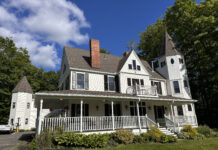
SOUTHBRIDGE – What do Robert F. Kennedy, Jr., Princess Diana and notorious murderers Nathan Leopold and Richard Loeb all have in common? The Optical Heritage Museum located in the town of Southbridge. The museum is nestled behind the Flatiron Building and houses over 3,000 frames, measuring equipment and ophthalmic items, including eyewear previously worn by celebrities.

Photo/Courtesy of the Optical Heritage Museum
Origins
In 1869, a Rhode Island jewelry apprentice founded the American Optical (AO) company in Southbridge. By 1892, it was the largest optical company in the world. Since that time and having produced so many optical products, Southbridge earned the unofficial title of “Eye of the Commonwealth.” Even though AO would eventually relocate to Illinois, the ties with the museum would remain undeniable.
American Optical had been making sunglasses for the U.S. military since 1935 and in 2023, teamed up with Huckberry to produce replicas of the aviator sunglasses worn on the moon by the 1969 Apollo 11 crew (Buzz Aldrin, Neil Armstrong, and Michael Collins).
After visiting the original AO site in Southbridge in 1958, President John F. Kennedy liked what he saw. He was so impressed with their stylish “Executive Bifocals” that he ordered three pairs, which the Optical Heritage Museum now displays. Sadly, the bifocals ordered arrived at the White House on the day Kennedy was assassinated in Dallas, Texas in 1963.
Also on display at the museum are Princess Diana’s AO industrial safety goggles which she wore while touring various plants like the new Sony plant that had opened in Wales in 1982 and a factory in Ipswich in 1990.
Solving cold cases
One of the most fascinating aspects of the museum’s history is how employees were able to assist in cold cases. In 2008, Dick Whitney, a former employee for AO and now curator and current operator of the Optical Heritage Museum, received a phone call from police in California. They had discovered a shallow grave containing a headless body alongside a pair of AO glasses.
Whitney’s first instinct was to call a family friend and the company’s former plant manager, Bob Haynes, and describe the situation. Upon a cursory look at photos from the coroner, Haynes believed the frame might be the company’s ‘Stadium’ frame. Whitney forwarded the information to the coroner while Haynes continued his search.
A few days later, Whitney received another email from Haynes identifying the frames as the “Clic.” Armed with this new information along with scans of the catalogue that Haynes had provided, Whitney informed the Marin County Coroner that the frames were likely the “Clic” women’s frame. His response was:
“This makes more sense, as we found some female clothes in the grave ̶ no skull or teeth. Any time frame on when these were in production for the Clic? Incredible work!”
Whitney provided the timeframe and shortly after that, he received a new email from the coroner:
“Mr. Whitney,
We have an ID in this case… our ‘Jane Doe’ went missing in May of 1964 – matching the timeline you’ve been able to provide. Thanks so much for your all your help!”
Years earlier, AO glasses played a role in assisting with the investigation into the kidnapping and murder of 14-year-old Bobby Franks of Chicago in 1921 at the hands of University of Chicago students Nathan Leopold and Richard Loeb. Along with young Franks’ body being found were pair of glasses fitted with an unusual hinge. At the time, there were only three people in the city who owned a pair, one of them being Nathan Leopold.
A trip to the Optical Heritage Museum is well worth the visit, from its display of the first driving glasses produced before the windshield was even invented to its “murder corner.”
More information about planning a visit is available at https://www.opticalheritagemuseum.com.
RELATED CONTENT:
Unusual museums make for some offbeat outings
Hudson museum offers a unique, immersive historical experience
Visit Old Sturbridge Village for a step back in time