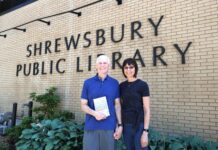
By Matt Robinson
Contributing Writer
BOSTON – Christina Inge is a longtime marketing maven who’s told the stories of a wide variety of organizations in many ways. But these days her tool kit is highly digital, including the strategic use of AI.
Digital infrastructure leader
A leader in digital infrastructure and outreach for over 20 years, Inge teaches at Harvard (where she won the Fussa Award for Teaching Excellence), Northeastern (where she is a founding lead faculty member for the NUMedia digital storytelling lab), and internationally (including a recent term at the Sorbonne in Paris), and has written textbooks that are used by over 1,500 schools around the world.

She is also the founder of Thoughtlight, a Boston-based digital media agency that supports individuals and organizations in using digital media to advance careers, communities, and causes.
Despite her expertise and accolades, when asked how she got into marketing, Inge is refreshingly blunt.
“Honestly” she admits, “I backed into it!”
Journalism background
Starting her career as a journalist, Inge’s skills were quickly recognized, and she was soon promoted to editor and was then recommended by for a position as an advertising copywriter.
“Eventually,” she recalled, “I landed a full-time job at a publisher’s in the market research department, translating industry studies into reports.”
As this opportunity allowed Inge to and explore what she sees as a “natural curiosity about why people make the choices they do,” she was quite content with the new direction her career had taken and began to delve deeper into the marketing world.
“Marketing, at its heart, is about understanding people,” she affirmed. “What they need, what motivates them, and how to connect them with solutions that genuinely help. Once I realized that, I was hooked! I’ve always been someone who notices patterns, and marketing is really just pattern recognition with a purpose.”
Launch of company
With this “purpose” in mind, Inge launched her own marketing company, which allowed her to pick her clients and colleagues.
“We work mainly with sustainable brands that have a mission,” she said proudly, “such as organic pet and personal care companies. It’s been an amazing journey and I love what I do every day!”
Inge’s interest in and passion for marketing is contagious, and she shares it with her clients and students on a daily basis – even those who might have been reticent to embrace it as she has.
“The technology has changed enormously,” she realized, “but the fundamentals haven’t. People still want to feel understood. They still respond to a message that speaks to their real needs. What’s different now is that we have incredibly powerful tools like artificial intelligence that can help us understand our audiences better and faster than ever before.”
Book targeted to ordinary people
In order to help people understand this new understanding, Inge offers her popular (and populist) book “Marketing Metrics,” which explains how everyone can use marketing to support themselves and their personal and professional ventures.

Photos/Submitted
“My books break all of this down in plain language,” Inge maintained. “I wrote them for real people who need marketing skills, not just tech whizzes.”
From data to dating, Inge said her books help you build brands while building confidence.
“You don’t need to become a computer scientist,” she assures. “You just need to understand enough to make smart decisions and not get left behind.”
Advice for older professionals
As anxieties regarding being left behind (or even left out) are especially prevalent among older people and professionals, Inge is keen to offer specific support to this population.
“When you’re looking for a new opportunity later in your career,” she observed, “you are the product…. Everything you’ve learned, every problem you’ve solved, every relationship you’ve built is your value. Marketing is simply the skill of communicating that value clearly.”
Whether you use traditional resumes or new-fangled tools like LinkedIn or Instagram, or even when introducing yourself IRL (”in real life”), what you share and what you project say a lot about you and can make the difference in how successful you are, she noted.
Fortunately, Inge maintains, people who have more experience IRL can have a distinct advantage, even over those who may be more used to using technology.
“You have real stories to tell,” she pointed out. “You’re not talking theory. You’ve lived the reality!”
Another anxiety that older folks face has to do with the prospect of learning new skills or even trying new professions later in life.
“It is never too late to reinvent yourself,” Inge asserted. “I’ve seen students in their 50s, 60s, and beyond completely transform their careers by learning a few key marketing skills. Understanding how to position yourself and tell your professional story is one of the most valuable things you can do at any age!”
Another key suggestion Inge makes is to realize and admit that the anxiety is normal and that you are not alone in feeling it
“I teach professionals of all ages,” Inge said, “and I can tell you that even people in their 20s feel overwhelmed by how fast technology changes.“
Again, however, Inge suggests that people with more life experience can have the upper hand, because they have already engaged so many new technologies throughout their lives.
“You went from typewriters to computers, from paper maps to GPS, from encyclopedias to Google,” she observed. “You’ve been adapting to new technology your whole life.”
AI can’t replace everything
As with any learning, Inge says that the secret is to start small.
“You don’t have to master everything at once,” she supports. “Try one tool. Ask one question. Watch one tutorial.”
The most important thing to remember, Inge concludes, is that, no matter how much data a computer can crunch, they will never have the often intangible but always vital benefits that come from living.
“The wisdom and judgment that come with experience are things AI cannot replace,” she said. “Technology is a tool. You are the one with the insight, the relationships, and the perspective to use it well. Don’t sell yourself short!”
RELATED CONTENT:
Former business executive now championing the cause of ‘conscious capitalism’
Business titan, philanthropist and politician Michael Bloomberg grew up in Medford
Massachusetts native Jack Welch was a successful but controversial business leader