By Sharon Oliver
Contributing Writer
DUNSTABLE – Arguably, any childhood school flashback could include the ringing of the school bell. It represented times for recess and school dismissals, but who can forget that welcoming sound signaling it was finally time for those midday hunger pains to be eradicated by a tasty lunch? No matter what was on the menu – pizza, hot dogs or fish sticks, along with of course a small container of milk, lunchtime was a highlight of the day.
Began as an experiment
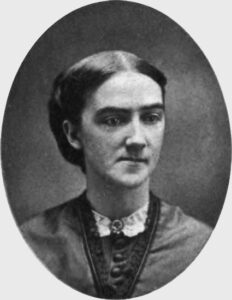
In 1890, home economics pioneer Ellen Swallow Richards and Mary Hinman Abel opened the doors of the New England Kitchen as an experiment to determine the successful conditions of preparing meals, by scientific methods, from the cheaper food materials, nutritious and palatable dishes, which should find a ready demand at paying prices.
Child nutrition was a great concern of Richards who believed “one of the natural outcomes of the work of the New England Kitchen was an endeavor to furnish the one-session schools of Boston, namely, the nine high schools, with a luncheon which should be wholesome, inexpensive, and sufficiently attractive.”
In 1892, Amy M. Homans, Director of the Boston Normal School for Gymnastics, commissioned Richard’s School Lunch Study, which was funded by Ella Sturtevant Kellen. Based on the results achieved two years later, the Boston School Board awarded the New England Kitchen a contract to provide school lunches for five cents each. By December 1894, Girls’ High School, the Boys’ Latin and English Schools, and the School of Mechanic Arts became the first public schools in the United States to participate in a school lunch program. Within a year, the Kitchen was serving 5,000 students every day.
Strong advocate
The first woman admitted to the Massachusetts Institute of Technology (MIT), Ellen Swallow Richards was a strong advocate for sanitation methods, providing school lunches and introduced courses in domestic science in public schools in Boston. She published her findings in 1895, asserting that within the short span of time in which her school lunch program had existed, the efficient and nutritious lunch service had immediately improved students’ attention spans and that the public began to recognize students who did not eat lunch could not be expected to perform well in school.
Richards was a scientist and MIT instructor whose research on the benefits of school lunch dates back to 1893. In 1910, sandwiches and milk were served for two days out the week. Since there were no lunchrooms in the building, children ate their meals at their desks. By the end of the year, lunch menu options improved to black bean soup, baked beans, ham sandwiches, and buttered corn muffins. The New England Kitchen program became an effective tool for instructing the value of nutrition. At the end of 1914, more than 24,000 children were offered a homemade lunch. Eventually, students were able to buy a complete lunch or individual items such as milk, soup, sandwiches, rolls, ice cream, and cakes.
New Deal program
During the Great Depression, food was extremely scarce. As a part of his New Deal, President Roosevelt bought up surplus food from farmers. He then hired thousands of out-of-work women to cook and serve the food to hungry public-school students. The program was so successful that by 1941 every state along with the nation’s capital had a lunch program in place. A typical school lunch at the time meant vegetable soup, peanut butter sandwiches, and the occasional piece of fresh fruit.
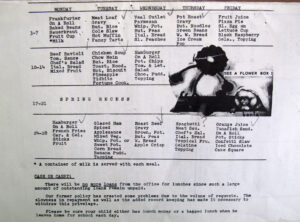
In 1946, President Harry S. Truman signed into law the National School Lunch Program to provide low-cost or free school lunch meals to qualified students through subsidies to schools.
The National School Lunch Act lays the foundation for ongoing federal support for school meal programs.
RELATED CONTENT:
Gone are the days of Boston department store charm schools
From admissions director to school founder – Christine Ozahowski