By Sharon Oliver
Contributing Writer
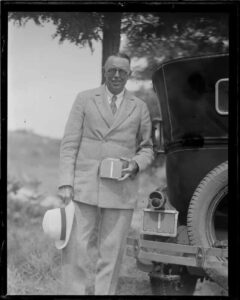
BROOKLINE – In 1903, Massachusetts and Missouri were the very first states to require drivers obtain a driver’s license. That same year, the first license plate issued by a state government was issued to wealthy car enthusiast Frederick Tudor of Brookline. A nephew of magnate and founder of the Boston Symphony Orchestra, Henry Lee Higginson, Tudor was working with the highway commission and persuaded the State Automobile Department to introduce mandatory state-issued license plates.
Registering early automobiles
Meanwhile, Higginson grew tired of people speeding on the roads near his summer estate and petitioned for drivers and vehicles to be registered. Having connections to high places paid off and an “automobile department” was created, requiring all drivers to register their vehicles and pay a $2 fee for state-issued license plates.
Prior to all this transpiring, the first official car-related death in the U.S. occurred in New York when a taxicab driver struck and killed a 68-year-old pedestrian. This prompted New York officials to require drivers to mark their cars with their initials in black over a white background. By 1903, there were 3,241 cars and 502 motorcycles across the Commonwealth fitted with blue plates, containing only one number painted in white with the words “Mass. Automobile Register” appearing above the number.
The first plate bearing the number “1” was issued to Tudor but the public display of driving around with such a marker provoked jealousy among some of the rich while others of the upper class saw it as shameless. Nevertheless, considering this occurred during a time when only the wealthiest of people could afford a car, it still prompted the rich to seek license plates since Tudor had seemingly started a trend with this new “status symbol.” Those with the lowest numbers on their plates were seen as the most influential members of the community.
This new trend eventually spread across the country and by the mid-1920s, all states required vehicles display state-issued license plates. Those eager to show their importance in public quickly snatched up plates with numbers 2 to 50. As more cars were manufactured and buying power increased, obtaining low numbers plates was no longer a status aspiration until years later.
Lottery for low number plates
In June of 2025, the Massachusetts Registry of Motor Vehicles (RMV) announced having applications for the 2025 Low Number Plate Lottery available online at myRMV Online Service Center beginning at 10:00 a.m. on Monday, June 16, 2025. To be eligible, applicants had to apply for the year’s lottery by 5:00 p.m. on Friday, August 15, 2025. Winners were notified by mail if selected for a low number plate. There were 283 plates available through the low plate lottery to include numbers 42, 108, 1997, 12K, X8 and A78.
The RMV has held lotteries to clear out low numbered plates from its inventory for years. Although owning a plate proudly showing one or two digits may mean an air of exclusivity, claiming to be number one will remain out of reach. At least for now. The Tudor family still has the coveted license plate No. 1 in Massachusetts and has been seen in recent years on a Mercedes station wagon belonging to one of Frederick Tudor’s descendants, traveling through Dartmouth and Westport.
In fact, many of the ten single digit plates are still in the hands of the families of its original owners. Owning a low number plate can be an obsession for some people. When the state introduced a “Cape and Islands” special plate in 2008, someone handed over $147,000 for the Number 1 plate. On the other hand, a single digit is also easy to remember.
RELATED CONTENT:
America’s auto industry got a significant start in Massachusetts
Marlborough’s A&M racetrack remembered decades later