By Matt Robinson
Contributing Writer
CAMBRIDGE – When self-described “jazz obsessive” saxophonist Russ Gershon started the Either/Orchestra in Cambridge in 1985, Ronald Reagan was president and the wreckage of the Titanic had just been discovered.
Now, 40 years later, Gershon’s “small big band” is still playing its idiosyncratic mix of large-ensemble jazz tunes. That is one of the reasons he feels there is so much excitement about the return of the Grammy-nominated and Boston Music Award-winning Either/Orchestra (E/O) to the Regattabar in Cambridge on December 17.
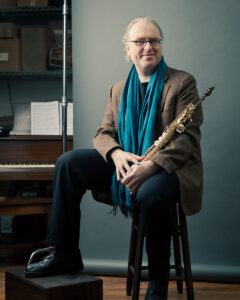
“It seemed to make perfect sense that we make our ‘re-debut’ at the Regattabar, where we’ve been playing since the 80s,” said Gershon.
Musical family
Born in 1959 and raised near New York by a “lifelong musician” mother who played in a community orchestra that featured an annual accompaniment of Gilbert and Sullivan operettas, Gershon was exposed to a wide range of sounds as a child and those diverse influences continue to play in his head (and his horn) today.
“I grew up with one foot in pop, one foot in jazz and a background in classical music,” he maintains, citing performances by Rostropovich, Marian Anderson, and Teddy Wilson among his early exposures to music.
Having had his mind blown by the Beatles at the age of five, Gershon also gravitated to such radio rulers as Herb Alpert and the Tijuana Brass and the made-for-TV band the Monkees. Citing a concert by Sly and the Family Stone when he was in ninth grade as a “game changer,” Gershon says that a pivotal moment on his path toward playing jazz was a concert by Alice Coltrane, Pharoah Sanders and Rahsaan Roland Kirk for which his father had procured tickets.
“Game over!” Gershon grinned. “I became a jazz obsessive.”
Though he had started piano lessons at seven and violin at nine, actual dreams of John Coltrane led him to land on the saxophone.
“Jazz [is] such a powerful musical and cultural conversation,” he observes, “that I felt compelled to join.”
Street education
And while his lessons were productive (as proven by his decades of performances), Gershon says that his real “education” in music came on the streets of New York and the clubs that were often underneath them.
“Growing up around New York City in the 1970s,” he said, “I was able to hear in person every generation of jazz player, a fantastic education. Now, as a music teacher and leader of younger musicians, I feel like I have to pass along the lessons of those experiences.”
Also during his teen years, the Nonesuch Explorer series introduced him to international sounds and he became a fan of the politically charged Nigerian musician Fela Kuti. In the late ‘70s the advent of punk and new wave brought him under the influence of such artists as Talking Heads and Television.
Record producer
While in an eclectic rock band called the Decoders in the early ‘80s, Gershon learned how to self-produce records. As a DJ in high school and as jazz director at Harvard’s WHRB-FM, Gershon also learned earlier how records were promoted. These lessons would serve him well when he started his own label – Accurate Records – in 1986.
“After I had started the Either/Orchestra, I realized that I could put out a jazz LP just like the rock bands I had been in,” he reasoned. “So, I brought my production, promotion and radio knowledge together and made our first album.”
Partnering with Cambridge-based Rounder Records for distribution, Gerson had all the pieces in place to produce and sell his own records and those of other artists he enjoyed.
“One thing led to another,” Gershon muses, “and I wound up putting out over 100 of other folks’ albums.”
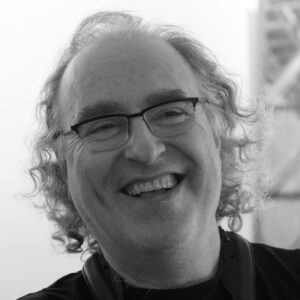
Speaking of other folks, when not performing with E/O, Gershon gigs with his jazz trio, his Latin Bugalú band Lookie Lookie, and a band that plays early ‘70s Miles Davis music called Listen to This.
Started as a rehearsal band
When asked how E/O came to be, Gershon recalls studying for a stint (as so many musicians do) at Berklee College of Music to shore up his music theory chops after he graduated from Harvard.
“At the end of that period, I wanted to keep developing my new skills,” he explains, “so I started a rehearsal band, luring a motley mob of players to my house on Monday nights to play my charts.”
As so many friends showed up regularly, Gershon was frankly concerned that the group was too big to make it as a “working” band. However, they booked a performance space anyway and, on December 17, 1985, Either/Orchestra (or “E/O” as it is known to its legions of devoted fans) was born.
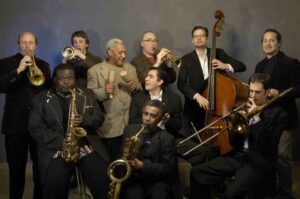
“The name came to me the morning after I heard Wayne Shorter play at Jonathan Swift’s,” Gershon said, name-checking an old favorite while predicting a follow-up question. “Even though I was a philosophy major in college, I didn’t intentionally name it after Kierkegaard’s book ‘Either/Or.’”
A large and diverse lineup over the years
While composing for the group, Gershon strove to create music that would keep him interested and entertained if he were in the audience. It turned out his instincts were correct, as the group gathered a strong following right away. The fact that E/O has enjoyed the influences and inspirations of over 60 artists (including such locally-sourced legends as John Medeski, Josh Roseman, Matt Wilson, and Miguel Zenón) has not hurt either, as the various members have brought their own influences to the music and their own friends to many shows.
“I’ve had so many incredibly talented people come through,” Gershon observed. “Everybody has left their mark on the group. So there are layers of musical history embedded in our repertoire.”
As diverse as their influences and membership have been, E/O has also enjoyed unique touring opportunities, including playing with members of the legendary Boston rock band Morphine and performing in Addis Ababa as part of an Ethiopian music festival in 2004.
“We were the only US band to do so,” Gershon recalled proudly, “and the first US big band in Ethiopia since Duke Ellington’s in 1973!”
E/O returned to Ethiopia in 2011 to perform music by Nerses Nalbandian, a refugee of the Armenian genocide who became the music director at Emperor Haile Selassie’s National Theater.
“We have continued to collaborate with Ethiopians,” Gershon noted, adding that a recording of one of these performances is due out soon.
Broad retrospective planned
In the meantime, Gershon is getting ready for the E/O reunion at the Regattabar on December 17, at which the current 10-piece “core” band will perform music from all 12 albums, as well as some cuts that are yet to be recorded but that always seem to please their crowds.
“It’s been a surreal experience, listening back to 40 years of music,” Gershon marveled. “Getting together to play has been very exciting, with so much history, and also several new members who are feeling the E/O vibe for the first time. We’ll do two completely different sets on December 17, so fans…will get quite a tour!”
RELATED CONTENT:
A lifetime in music: jazz singer Ron Murphy